Logistics
How to Accurately Classify Goods Using HS Codes
Jun 1, 2025
Global Trade
Learn how HS codes help determine required import documents, including licenses, certificates and customs requirements for different products and countries.
July 25, 202612 min readView as Markdown
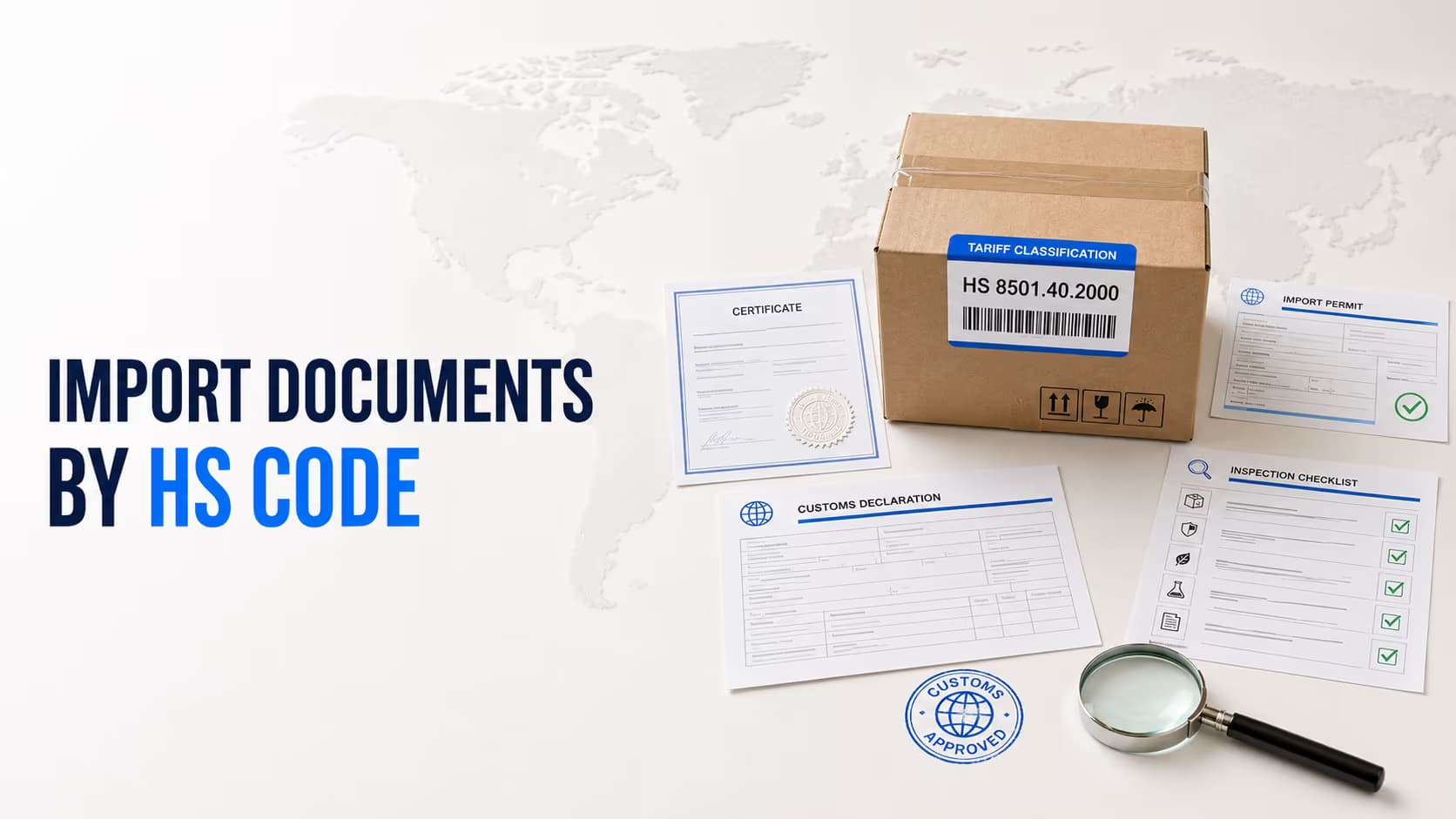
Importing a product involves much more than preparing a commercial invoice and arranging transportation.
Depending on the product, destination country and intended use, an importer may need customs declarations, certificates of origin, import licenses, inspection certificates, sanitary permits, test reports or other product-specific documents.
An HS code can help identify many of these requirements.
However, an HS code does not determine every document by itself. The final list of required import documents may also depend on the destination country, country of origin, product composition, regulatory authority and the purpose for which the goods will be used.
This guide explains how HS codes relate to import documentation, which documents are commonly required and how importers can research product-specific requirements before a shipment is dispatched.
Import documents are the records, declarations and certificates used to move goods legally from one country into another.
Customs authorities use these documents to confirm:
Some documents apply to almost every commercial shipment. Others are only required for specific products or trade routes.
For example, a shipment of industrial machinery may require technical specifications or conformity documentation, while imported food may require health certificates, ingredient information and inspection records.
The correct documentation therefore depends on the transaction as well as the product.
The Harmonized System is an international product nomenclature developed and maintained by the World Customs Organization. An HS code is a standardized numerical classification used to identify traded products.
Customs authorities use HS codes to connect a product with:
Because many customs and regulatory measures are organized by tariff classification, identifying the correct HS code is often the first step in determining which import documents may be required.
For example, two products that appear commercially similar may fall under different HS codes because of differences in material, composition, processing or intended use.
Those different classifications may trigger different documentation requirements.
A food preparation and a pharmaceutical product, for instance, may contain similar ingredients but be regulated very differently. One may require ordinary food import documentation, while the other may require pharmaceutical registration, an import license or approval from a health authority.
This is why import documents by HS code can be a useful starting point—but not the final answer.
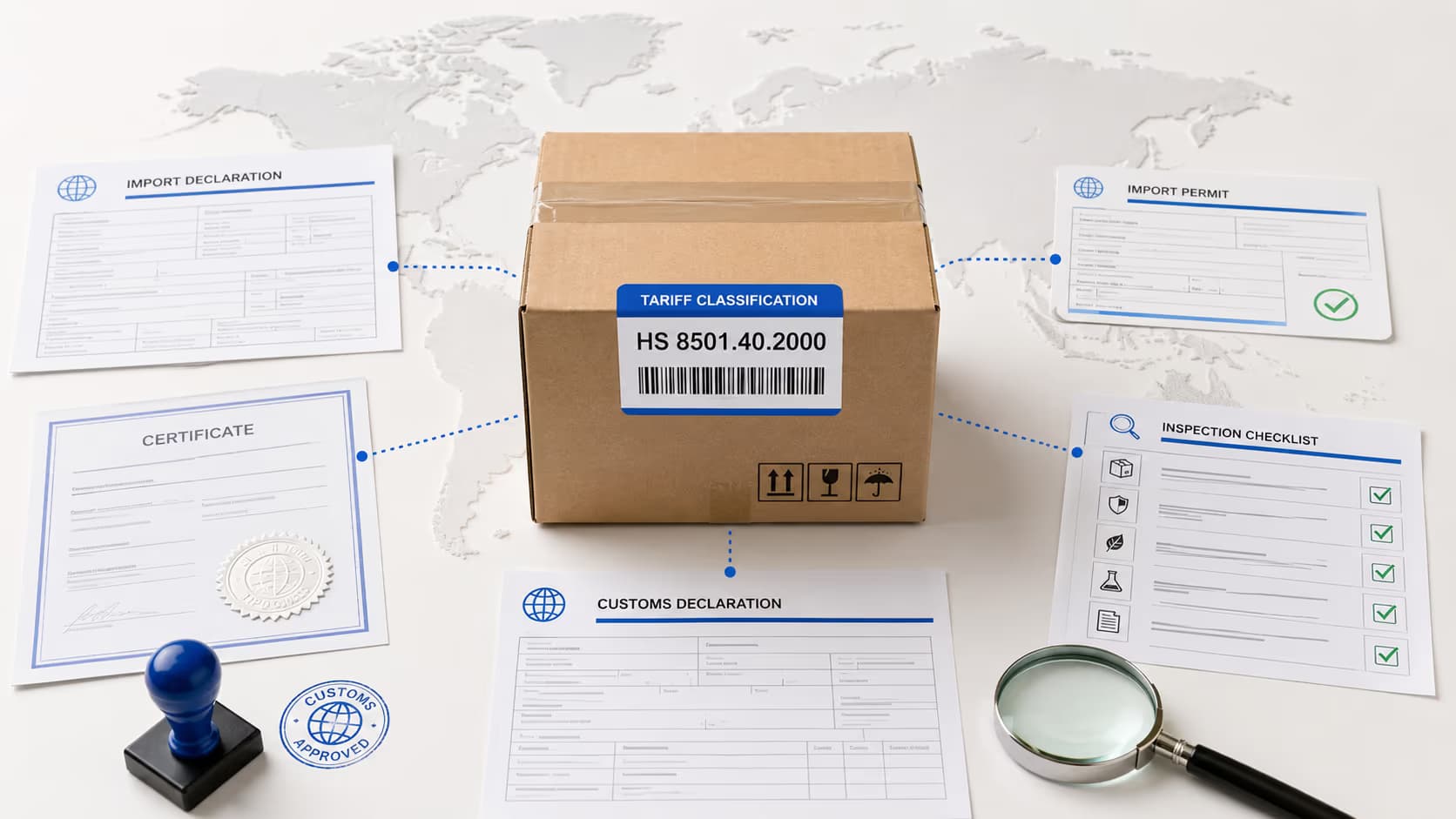
Although requirements vary, several documents appear in most international import transactions.

The commercial invoice is issued by the seller to the buyer and normally includes:
Customs authorities often use the commercial invoice as a primary source for customs valuation.
Descriptions should be specific enough for customs to understand the product. Generic descriptions such as “parts,” “samples” or “accessories” may result in questions, delays or classification disputes.
A packing list provides information about how the shipment is physically packed.
It may include:
Customs officers, freight forwarders and inspection agencies may use the packing list to identify and examine individual packages.
The transport document confirms that the carrier has received the goods for shipment.
Common examples include:
The required format depends on the transport mode and contractual arrangements.
The importer or customs representative files an import declaration with the destination-country customs authority.
The declaration commonly includes:
The HS code entered on the declaration can directly affect the duties, controls and documents applied to the shipment.
A certificate of origin confirms where the goods were produced or manufactured.
It may be required to:
Not every shipment requires a formal certificate of origin. The required format depends on the destination country, trade agreement and applicable origin rules.
An insurance certificate may be required when cargo insurance is included in the sales contract, financing arrangement or documentary credit.
It can also support customs valuation when insurance costs form part of the customs value.
Some of the most important import documentation requirements are product-specific.
Once a product has been classified, the HS code can be used to research whether it is controlled by customs or another government authority.
Food, agricultural and animal-origin products, such as products classified under Chapter 08 for fruit and nuts or Chapter 09 for coffee, tea and spices may require health, phytosanitary or inspection documentation:
The exact requirements depend on the type of product and the rules of the importing country. For example, food imported into the United States may be subject to FDA facility-registration, prior-notice, labeling and supplier-verification requirements.
Fresh fruit, processed food, animal feed and frozen meat may all be subject to different authorities and documentary controls.
Chemical products may fall under classifications such as inorganic chemicals in Chapter 28, organic chemicals in Chapter 29, or specialized chemical products in Chapter 38.
The chemical name alone may not be enough to identify the correct requirements. Concentration, intended use and hazardous properties can also affect regulation.
Pharmaceuticals are generally classified within HS Chapter 30, while many medical, surgical and diagnostic instruments appear under HS Chapter 90.
A product's intended medical use can be particularly important. A general consumer product and a medical device may have similar physical characteristics but face very different import requirements.
Many electrical and electronic products are classified under HS Chapter 85, although the exact heading depends on the product's function and components.
Wireless devices may be regulated not only by customs but also by telecommunications authorities.
Textile documentation can differ significantly between raw materials such as cotton under Chapter 52, knitted apparel under Chapter 61, and non-knitted apparel under Chapter 62.
Documentation may vary depending on whether the product is fabric, finished apparel, protective clothing or children's clothing.
Most mechanical machinery is classified within HS Chapter 84, while electrical machinery is commonly classified under Chapter 85.
Used machinery may face additional documentation or inspection requirements in certain markets.
An import license is an official authorization allowing a particular product to enter a country.
Licensing requirements may apply to products such as:
Some licenses are automatic and primarily used for administrative monitoring. Others are non-automatic and may require a detailed review before approval.
The HS code is frequently used to determine whether a product appears on a licensing list. However, importers should also verify:
A classification match does not always mean that every product within the HS code is licensed. Conversely, a regulated product may require approval because of its use or composition even when the tariff description appears broad.
In addition to import licenses, customs may require supporting certificates or permits before releasing the shipment.
These may include:
A conformity certificate demonstrates that the product meets local technical or safety standards.
Some countries require conformity assessment before shipment. Others inspect or test the product after arrival.
An inspection certificate may confirm the product's quantity, quality, condition or compliance.
Inspection may be performed by:
Sanitary and phytosanitary documents are commonly required for food, plants, animals and related products.
Their purpose is to prevent the spread of disease, pests and unsafe products.
Test reports may be required to prove compliance with safety, chemical, electrical, performance or environmental standards.
Importers should confirm whether the testing laboratory must hold a particular accreditation.
Controlled goods may require documentation explaining who will use the product and for what purpose.
These requirements are common for dual-use goods, controlled chemicals, sensitive technology and certain industrial equipment.
The same HS code does not always lead to the same import documents in every country. For EU-bound goods, the European Commission's Access2Markets portal provides destination-specific information on tariffs, rules of origin, taxes, import procedures and product requirements.
The first six digits of the Harmonized System are internationally standardized, but countries often add additional digits to create national tariff classifications.
More importantly, each country establishes its own:
For example, a product may require a conformity certificate in one market, registration with a specialist authority in another market and only standard customs documents in a third.
The country of origin can also change the requirements.
Origin may affect:
This means that a complete documentation check should consider the entire trade corridor, not only the product's HS code.
At minimum, the importer should verify:
A practical documentation research workflow can follow these steps.

Collect detailed information such as:
A vague product description can result in the wrong classification and the wrong documentation checklist.
For formal classification research, consult the applicable national tariff and the WCO's published HS nomenclature and interpretation rules.
For difficult products, check:
Do not select an HS code only because a competitor or supplier uses it. The correct classification depends on the actual characteristics of your product.
After identifying the international six-digit code, confirm the full national tariff code used by the destination country. For example, coffee products begin within HS heading 0901, but roasted, decaffeinated and non-decaffeinated products can fall into different subheadings.
National subdivisions can trigger additional measures or reporting requirements.
Review the measures attached to the tariff code, including:
After confirming the HS code, use a route-specific tariff and product-requirement lookup to check duties, taxes, trade remedies and available preferential treatment.
Many product requirements are enforced by authorities other than customs.
Depending on the goods, this may include agencies responsible for:
Customs is not always the only reviewing authority. In the United States, entries for FDA-regulated products are submitted through CBP and referred to FDA for admissibility review.
Before shipping, confirm the latest requirements with official customs and regulatory sources.
For higher-risk products, importers may also consult:
Do not wait until the goods reach the destination port to discover that a permit, inspection or certificate was required before shipment.
Some documents must be issued in the exporting country. Others must be approved before the cargo is loaded.
Missing a pre-shipment requirement can result in:
Importers frequently encounter problems because they:
A more reliable process connects product classification with the complete trade corridor and applicable regulatory controls.
Finding an HS code should not be the end of the research process.
After classification, an importer usually needs to answer a series of connected questions:
EximAgent is designed to support this workflow by helping trade teams move from a product description to the next practical research task.
Instead of searching through disconnected tariff directories, regulatory pages and customs sources one by one, users can start with an HS code and investigate the requirements connected to the intended market.
EximAgent's public HS code pages also help users explore tariff headings and understand where a product may belong before moving into deeper trade research.
The goal is not simply to display an HS code. It is to help the user move from:
“What is my product's HS code?”
to:
“What do I need to do before I can import or export this product?”
Before shipping, confirm that you have reviewed:
The exact required import documents depend on the product and trade route.
An HS code provides an essential starting point, but accurate compliance research should combine classification with the destination country, origin, product details, intended use and applicable regulatory authority.
Researching a product's HS code? Explore the relevant HS heading and use it as the starting point for checking tariffs, trade flows and product-specific import requirements.
Classify your product and start checking its trade requirements in EximAgent.
Enter your email to receive the latest trade insights, guides, and HS-code explainers from EximAgent Blog.