Global Trade
Import vs Export: Navigating Global Trade and Compliance
Dec 4, 2025
Export Import
A field guide to closing global trade deals while controlling contract, customs, and logistics risk.
June 10, 2026By Davos Pham10 min readView as Markdown
ANSWER-FIRST SNAPSHOT Practical import-export negotiation competence rests on three disciplines: negotiating contracts that allocate risk before money moves, mastering Incoterms and payment instruments so liability is never ambiguous, and building a troubleshooting system for the customs, logistics, and cultural failures that will occur. Treat every clause as a risk-transfer decision, not paperwork.
You sent two hundred outreach emails and heard nothing back. The problem usually isn’t your product or your price — it’s that the message read like a broadcast, not a partnership proposal. The same instinct that kills cold outreach kills deals at the table: treating international trade as a transaction instead of a structured exchange of risk.
This guide rebuilds the fundamentals into frameworks you can actually run — covering negotiation, contract architecture, real-world troubleshooting, and the cross-cultural fluency that separates operators who close from those who collect “we’ll think about it” replies.
Here is the misconception that costs exporters the most money: the belief that a Letter of Credit (L/C) guarantees you get paid.
It does not. An L/C is a conditional instrument. The bank pays only if your documents comply perfectly with the credit’s terms — and in practice, most don’t on the first try. The International Chamber of Commerce has long estimated that 60–80% of L/C documents are rejected on first presentation, almost always over discrepancies that have nothing to do with the goods: a misspelled name, a date outside the shipment window, an invoice description that doesn’t match the credit word-for-word, a missing signature.
When your documents are refused, control of the payment decision quietly shifts back to the buyer, who must now waive the discrepancy for you to be paid. The very instrument you bought for security has handed leverage to the other side.
The practitioner’s takeaway: an L/C protects you only to the degree your documentation discipline is flawless. The instrument is not the safeguard — your document control is. This is precisely where modern AI trade platforms now earn their keep: automated checkers compare draft documents against the credit’s terms line by line before bank presentation, catching the conflicts that would otherwise trigger a refusal.
“A Letter of Credit guarantees payment only against perfect documents — not against a successful shipment.” Data: The ICC estimates 60–80% of letters of credit are refused on first presentation due to documentary discrepancies. Under UCP 600, documents must be presented within 21 days of shipment (or by L/C expiry, whichever comes first). A single rejection delays settlement, adds bank fees, and returns the payment decision to the buyer. Conclusion: Treat documentary compliance as a primary commercial risk, not a back-office formality. Pre-screening every document against the credit’s exact terms — increasingly automated by AI trade-finance tools — is the difference between getting paid on time and negotiating from weakness after the goods have shipped.
In global trade and the way for import-export negotiation - the contract is where risk is priced and assigned. Most of the cost of a bad deal is locked in before the first container moves.
The strongest negotiators arrive already knowing the answer. Run this before any first contact:
Amateurs anchor on unit price. Professionals trade across the entire surface of the agreement.
A defensible foreign trade contract must pin down each of these without ambiguity:
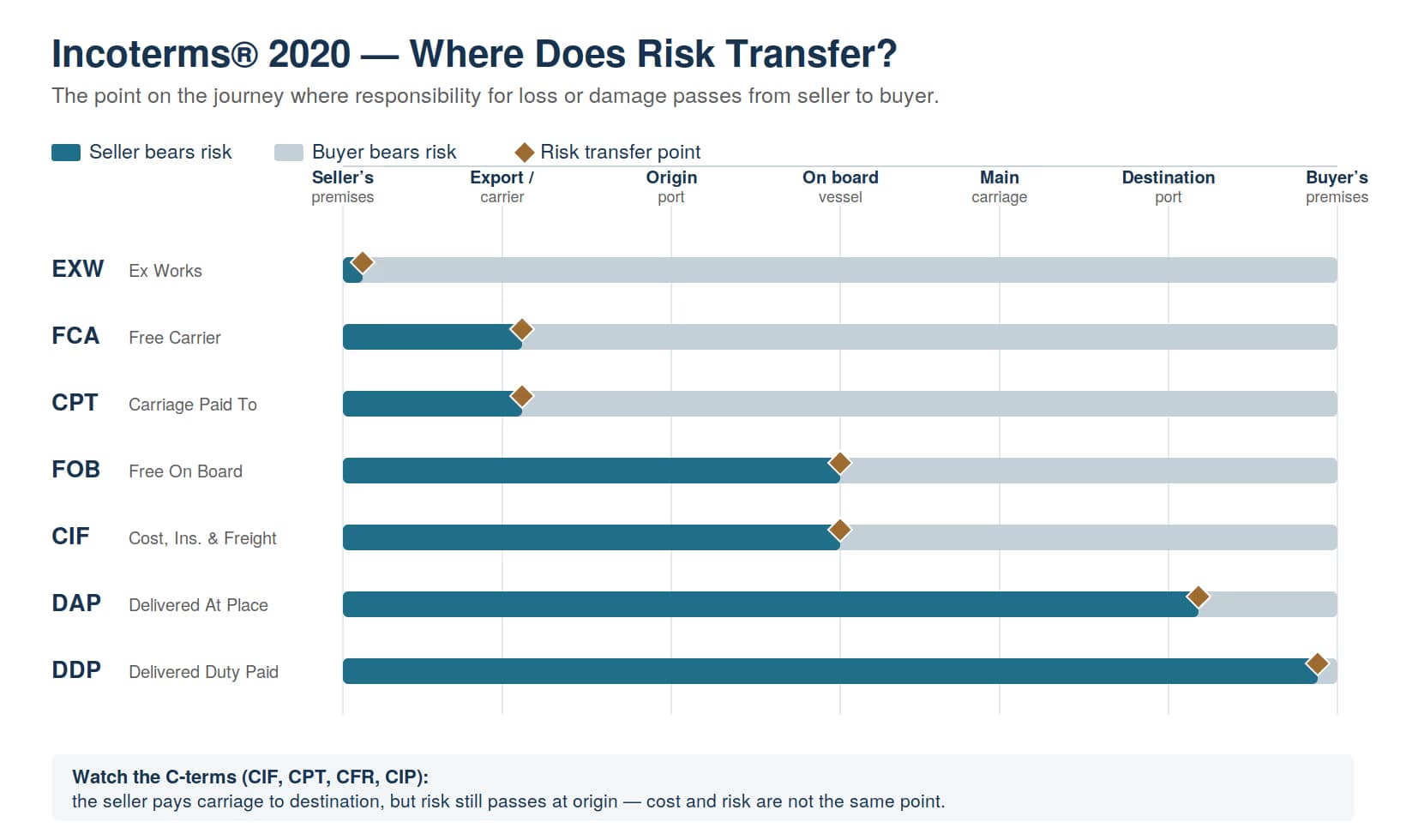
[ Visual Placeholder: Incoterms 2020 — risk-transfer point for each rule, seller vs. buyer ]
MINI CASE STUDY — The CIF vs. FOB Trap A coffee exporter quotes CIF Rotterdam to a German buyer, assuming “CIF” simply means “I’ll cover the freight.” Mid-voyage, the vessel is delayed by port congestion and part of the cargo spoils. The buyer demands the seller absorb the loss. The misunderstanding: under CIF, the seller pays for freight and insurance, but risk transfers to the buyer the moment goods cross the ship’s rail at origin. The loss is the buyer’s to claim against cargo insurance — not the seller’s to eat. But because the contract never specified the insurance coverage level (Institute Cargo Clauses A vs. C), the policy didn’t cover the loss. Both sides lose. The lesson: Incoterms allocate risk, but they don’t write themselves into the policy. Always specify the coverage class, not just the rule. A risk-transfer point with the wrong insurance behind it is a gap waiting to be paid for.
Disruptions are not the exception in international trade they are the operating condition. Professionalism is measured by how you respond, not whether problems occur. So that the on the import-export negotiation here are important things should noticed about:
Documentation issues should also be included in the shipment's broader [import-export risk planning].
MINI CASE STUDY — When the Clock Becomes the Cost An importer’s electronics shipment is flagged for a random customs exam at the destination port. The exam takes four days. During those four days, the container sits past its free time, accruing demurrage. In the current market that meters at roughly $150–$300 per day per container — and those charges have risen 12–18% year over year as port congestion and regulation bite. A single container quietly adds $600–$1,200; across a 20-container booking, the “small delay” becomes a five-figure hit that erases the order’s margin. The lesson: the cargo wasn’t damaged and nothing was mis declared — the cost was time. Building free-time buffers into contracts, pre-clearing customs where possible, and tracking last-free-days in real time (the core use case for shipment-monitoring AI) is how operators stop demurrage from eating profit.
Language and etiquette can quietly kill a deal that the numbers should have closed.
Market | Negotiation Style | What Builds Trust | Common Mistake to Avoid |
Japan | Formal, consensus-driven, patient | Courtesy, precision, respect for hierarchy; proper card exchange | Rushing the decision or appearing aggressive |
United States | Direct, fast, results-focused | Clarity, decisiveness, hitting commitments on time | Over-padding emails; vagueness on terms |
China | Relationship-first, long-horizon | Personal rapport built before hard bargaining | Diving into price before building the relationship |
Beyond style, three habits travel across every market:
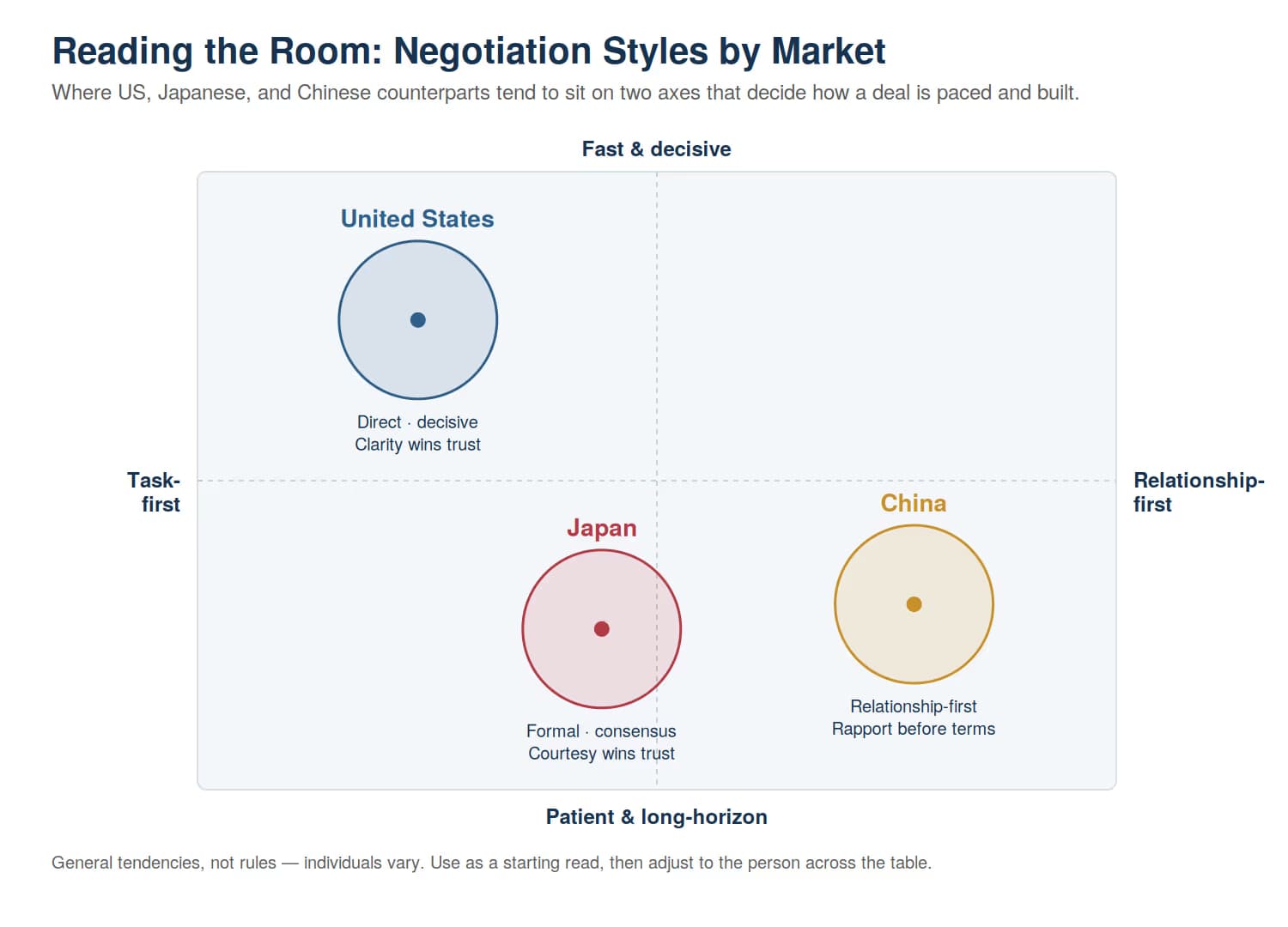
[ Visual Placeholder: Comparison table of negotiation styles across the US, Japan, and China ]
What is the most common reason export contracts fail?
In the import-export negotiation the ambiguity in risk allocation — most often an Incoterms misunderstanding or a payment instrument mismatched to the trust level of the relationship. Disputes usually trace back to a clause that was never made explicit.
Is FOB or CIF better for the seller?
Neither is universally better. Under FOB, the seller’s risk ends once goods are loaded at origin, keeping exposure tight. Under CIF, the seller arranges freight and insurance but risk still transfers at origin — more coordination burden without more risk after loading. The right choice depends on who can better manage freight and what insurance coverage is specified. This is also very helpful for import-export negotiation.
Why are so many letters of credit rejected?
Because the bank examines documents against the credit’s exact wording, and the standard is perfection. The ICC estimates 60–80% are refused on first presentation over discrepancies like name spellings, date conflicts, or invoice descriptions that don’t match the credit verbatim.
How can businesses reduce customs and demurrage risk?
Accurate HS-code classification and complete documentation prevent most holds; free-time buffers and real-time last-free-day tracking prevent most demurrage. AI screening tools that validate declarations before filing and monitor shipments in transit now handle much of this proactively.
How is AI changing import-export operations?
AI agents verify partner legitimacy and solvency before negotiation, pre-screen customs declarations for errors, check L/C documents for discrepancies before bank presentation, and monitor shipments to head off demurrage — automating the high-risk, detail-heavy checkpoints where deals and margins are usually lost.
To know more about import-export negotiation follow Exim Agent Blogs and click for free trial beta to get the exposure.
Enter your email to receive the latest trade insights, guides, and HS-code explainers from EximAgent Blog.