Global Trade
The AI Trade Revolution: Reshaping Global Commerce
May 28, 2026
Global Trade
The HCMC government has proactively outlined three economic growth scenarios for 2025, accompanied by seven strategic solution groups to adapt and...
April 10, 2025By Davos Pham4 min readView as Markdown
Amid the United States’ new protectionist tariff policy, export-driven economies like Vietnam—especially Ho Chi Minh City—are facing significant challenges. As the country’s economic engine and southern trade hub, HCMC is not only directly affected but also serves as a "barometer" for the broader economic health of Vietnam’s southern economic zone.
In response, the HCMC government has proactively outlined three economic growth scenarios for 2025, accompanied by seven strategic solution groups to adapt and maintain momentum. These actions go beyond short-term reactions; they reflect forward-thinking governance and a long-term vision.
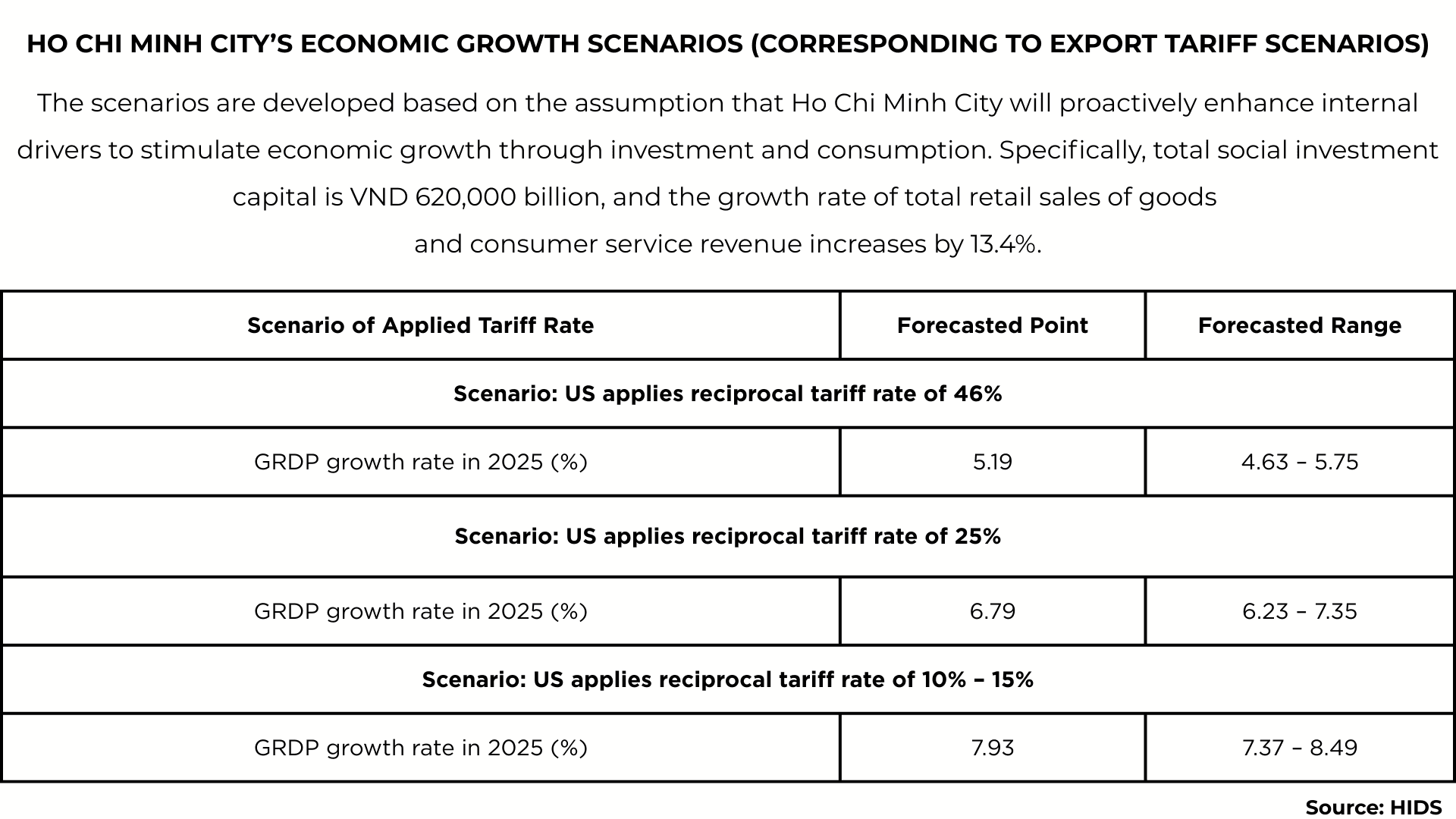
At the scientific seminar titled “Ho Chi Minh City’s Economic Growth Amid the Impact of New U.S. Tariff Policies,” the HCMC Institute for Development Studies introduced three growth scenarios based on projected U.S. tariff levels. This rare move underscores a multidimensional and evidence-based planning mindset from a local authority.
This worst-case scenario anticipates a GRDP drop of 2–2.5%, pulling HCMC’s economic growth rate down to 4.63–5.75% in 2025. Compared to the national growth target of 8.5%, this gap highlights the urgent need for robust intervention.
With successful negotiations to reduce tariffs, HCMC’s GRDP would decline only by 1.6–1.9%. The growth rate would rise to 6.23–7.35%, falling short of the national goal but still preserving the city's competitive regional standing.
In the best-case scenario, GRDP would shrink by only 1–1.3%, enabling a growth rate of 7.37–8.49%—nearly hitting the 8.5% target. This scenario represents the city’s ideal outlook if both external negotiations and internal improvements align.
To turn positive scenarios into reality and mitigate the worst effects of U.S. tariffs, the HCMC Institute for Development Studies has proposed seven solution groups. These strategies serve both immediate responses and long-term economic direction.
Key to mitigating impact is establishing a bilateral dialogue mechanism to ease trade tensions. HCMC can act as a bridge between local businesses and central authorities, providing data and real-world feedback to expedite negotiations.
The U.S. has raised concerns over goods from third countries being relabeled as Vietnamese to circumvent tariffs. Enhancing transparency and governance across supply chains will not only rebuild trust but also ensure long-term trade integrity.
An intelligent reciprocal strategy involves increasing Vietnam’s import of American high-tech products. This will help balance trade, modernize local production, and accelerate digital transformation across industries.
Beyond trade, Vietnam—especially HCMC—should proactively attract direct investments from American businesses. This strategy facilitates supply chain localization, creates jobs, and enhances Vietnam’s position in global value chains.
Relying solely on the U.S. is a high-risk strategy. HCMC must expand export markets to the EU, Middle East, Canada, Mexico, and beyond through agreements such as EVFTA, RCEP, CPTPP, USMCA, CEPA, and VIFTA. This will build resilience and reduce over-dependence on one market.
HCMC must boost intra-regional connectivity, leveraging regional trade agreements like ASEAN and RCEP to build local supply chains. This minimizes exposure to global shocks while enhancing competitiveness.
Ultimately, sustainable strength lies in internal capabilities. HCMC should support small and medium-sized enterprises (SMEs) in product restructuring—shifting toward high-value-added goods less vulnerable to tariff impacts, especially in electronics, technology, and processed agriculture.
HCMC has long been Vietnam’s largest import-export gateway. In 2024, exports to the U.S. reached $7.8 billion, while imports were only $3 billion, yielding a surplus of $4.8 billion. Any major change in U.S. policy inevitably sends ripple effects through HCMC’s economy—and the southern economic zone at large.
The city’s recent actions—from scenario planning to expert consultations and actionable policy proposals—are not merely reactive. They reflect a forward-leaning governance model, positioning HCMC not only as an economic engine but as a strategic hub for risk management and global integration.
Enter your email to receive the latest trade insights, guides, and HS-code explainers from EximAgent Blog.