Global Trade
The AI Trade Revolution: Reshaping Global Commerce
May 28, 2026
Global Trade
Analyzing the $28.38B India April exports trade deficit caused by the Hormuz oil shock, even as overall exports hit a 4-year peak of $43.56B.
May 15, 2026By Davos Pham10 min readView as Markdown
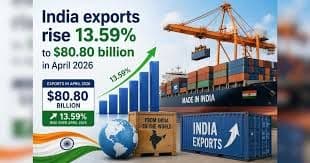
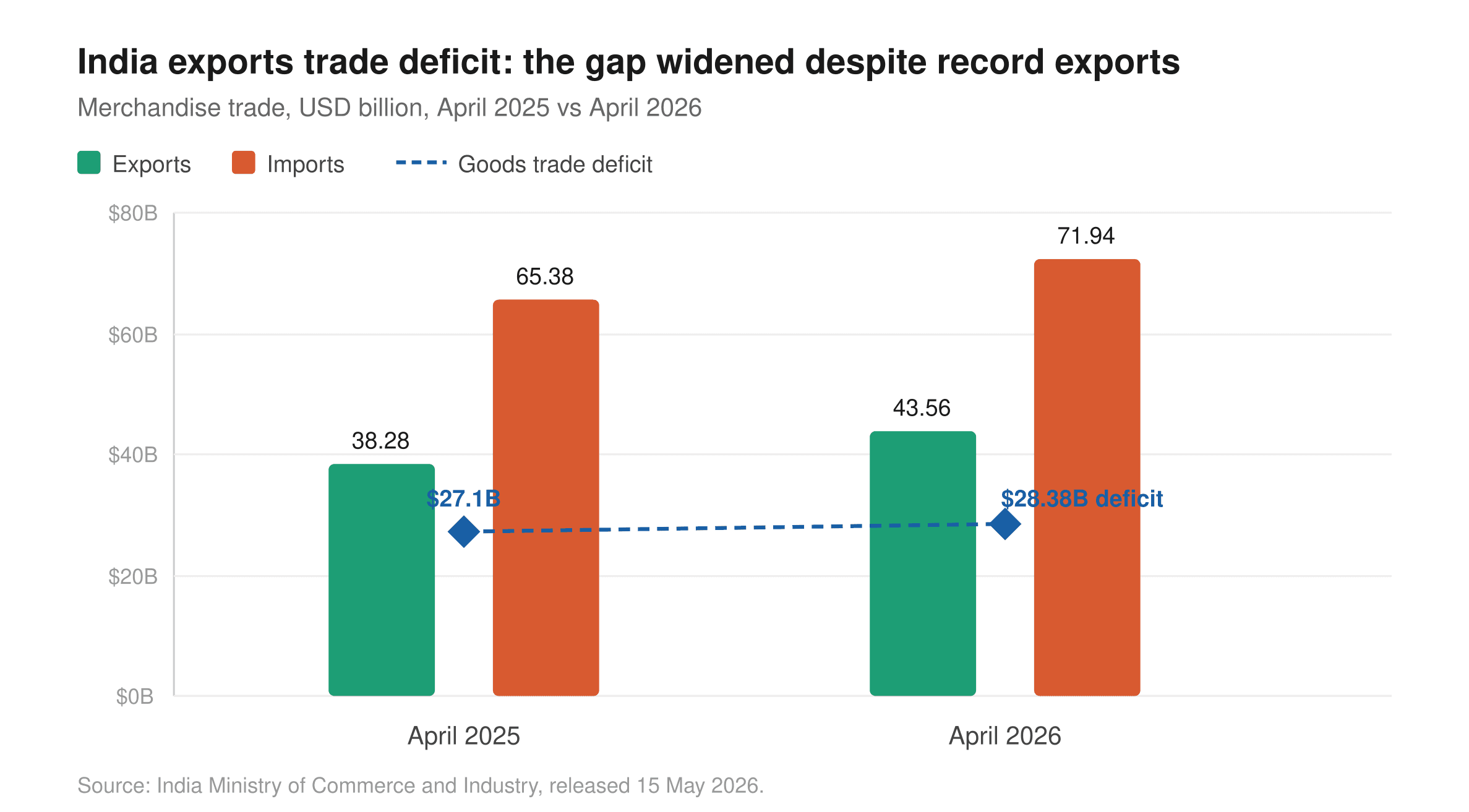
Quick answer: The India April exports trade deficit story is a paradox: India's merchandise exports rose 13.78% year-on-year to $43.56 billion — the highest monthly goods export figure in more than four years — yet merchandise imports climbed 10% to $71.94 billion, pushing the goods trade deficit to a three-month high of $28.38 billion, up from $27.1 billion a year earlier. The widening gap was driven almost entirely by a higher energy import bill caused by the Strait of Hormuz blockade and the lapse of India's US waiver on Russian crude — not by weak exports, which were the strongest in years.
Dateline: New Delhi | Filed: May 16, 2026
Metric (April 2026) | Value | Year-on-Year Change |
|---|---|---|
Merchandise exports | $43.56 billion | +13.78% (from $38.28B) |
Merchandise imports | $71.94 billion | +10% (from $65.38B) |
Goods trade deficit | $28.38 billion | Widened from $27.1B; 3-month high |
Services exports | $37.24 billion | Up from $32.85B |
Overall exports (goods + services) | $80.80 billion | Up from $71.13B |
Overall trade deficit | $7.81 billion | Narrowed from $11.16B a year ago |
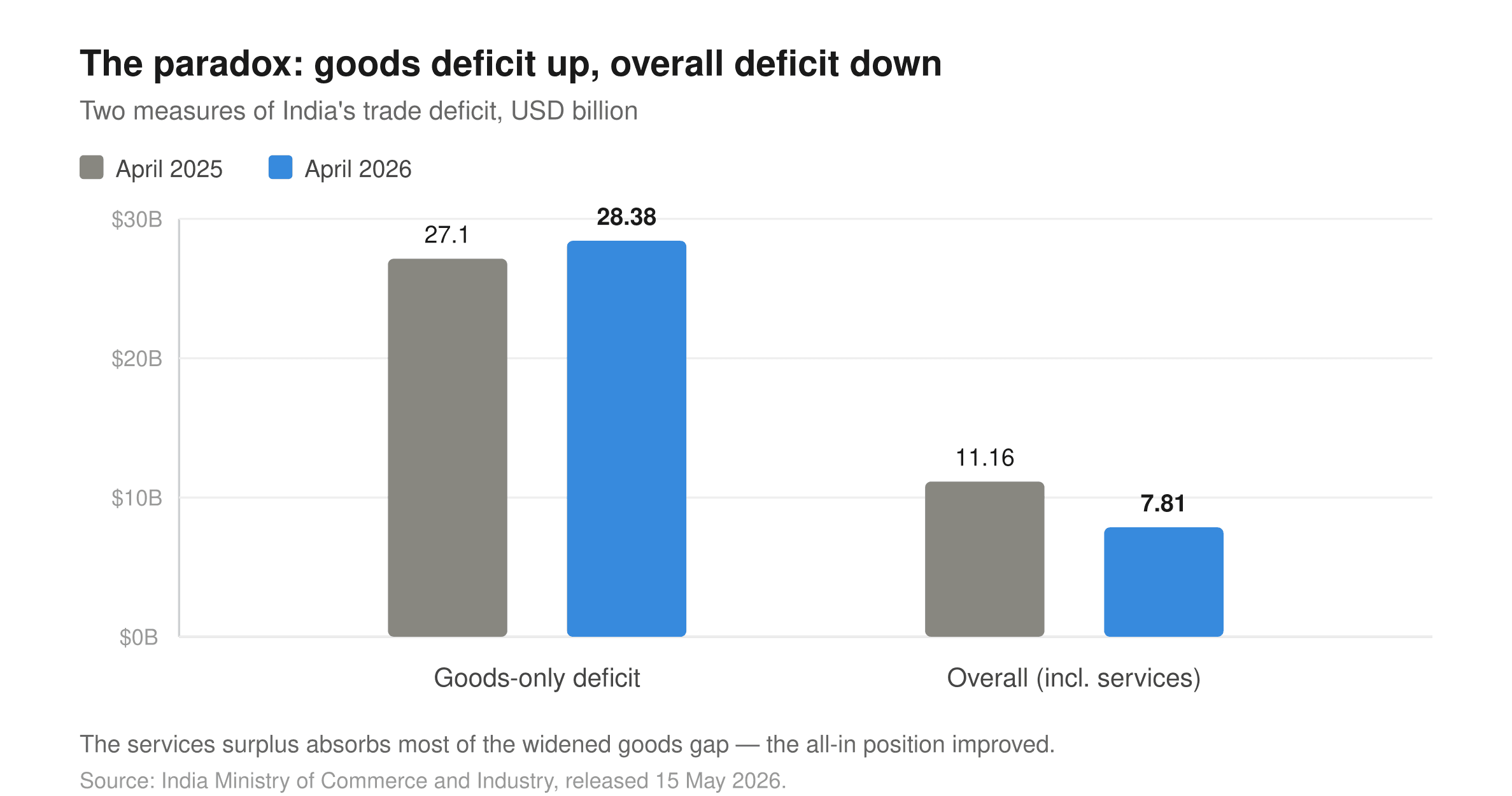
The headline contains a paradox worth understanding immediately, and it sits at the heart of the India exports trade deficit picture: the goods deficit widened, but the overall deficit — which includes India's powerful services surplus — actually narrowed sharply. Both statements are true, and which one you lead with shapes the entire story.
India opened its 2026–27 fiscal year on an unexpectedly strong note. According to data released by the Ministry of Commerce and Industry on Friday, India's overall exports, including merchandise and services, stood at USD 80.80 billion in April 2026, up from USD 71.13 billion in April 2025. On the goods side specifically, exports of goods rose to $43.56 billion from $38.28 billion last year, while imports climbed to $71.94 billion from $65.38 billion, lifting the visible trade gap to $28.38 billion.
This is the highest monthly merchandise export figure India has recorded in more than four years. It is also a print that arrived against one of the most hostile global trade backdrops in recent memory.
The deeper story — the one the raw deficit number obscures — is that this widening gap is overwhelmingly an import-price event, not an export-weakness event. The value of imports soared as international oil and gas prices jumped amid the Middle East conflict that forced India and every other major crude oil importer to source more expensive supply from producers not dependent on the Strait of Hormuz, which remains closed to most tanker traffic. The trade gap in April widened by $8 billion compared to the $20.6 billion deficit in March, and was higher than economists had expected at about $26 billion.
To understand April's numbers, you have to understand that India walked into the month caught in a three-way energy vice. This is the part of the story most worth reporting, because the export number is a symptom of resilience while the import number is a symptom of crisis.
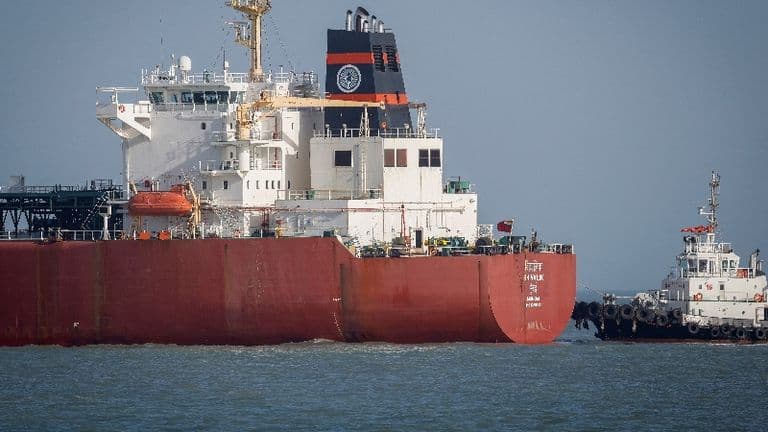
The Strait of Hormuz — through which roughly a fifth to a quarter of the world's seaborne oil and LNG normally transits — has been largely closed since late February 2026, when conflict between Iran and a US–Israel coalition erupted. For India, which sits at the junction of the Gulf and Red Sea shipping corridors, this is acutely painful. India imports more than 85% of its crude oil — around 5.5 million barrels per day — making it the world's third-largest oil importer. With Gulf barrels stranded or rerouted via the longer, costlier Cape and Red Sea paths, the price per barrel landed in India rose sharply even where volumes held.
The trade data shows this in the regional breakdown: India's exports to West Asia declined 28 per cent to $4.16 billion last month as against $5.78 billion in April 2025, while imports from the region dipped 31.64 per cent to $10.47 billion in April from $15.32 billion in the year-ago period. Note the dynamic: West Asian volumes collapsed on both sides, yet the overall import bill still rose 10% — because the oil India could still buy cost dramatically more.
Compounding the squeeze, a US waiver that had allowed India to continue buying discounted Russian crude expired on April 11. India had bought roughly 1.5 million barrels per day of Russian oil in March under a specific carve-out; when that lapsed mid-month, a second major supply lane narrowed at the worst possible time. Analysts described India as facing a mounting supply squeeze "with the loss of Iranian barrels, plus not getting the Russian barrels" — the country had just taken its first Iranian oil shipment in seven years before the Hormuz route seized up.
The third front is policy. An additional 25% US tariff imposed on Indian exports — tied to accusations that New Delhi was indirectly funding Russia's war effort through discounted crude purchases — continues to shape trade flows. India's response, cutting Russian purchases and pivoting to Middle Eastern supply, is precisely the strategy that the Hormuz blockade then unravelled. The data captures the cost: India's exports to the United States rose only marginally to USD 8.48 billion in April 2026 from USD 8.38 billion a year earlier — near-flat performance to India's largest single trade partner in a month when exports everywhere else surged.
The takeaway for trade professionals: the April deficit is best read not as a competitiveness problem but as a geopolitical energy-cost shock layered on top of an otherwise strong export base. That distinction matters enormously for anyone forecasting Indian demand, freight, or compliance exposure over the next two quarters.
If imports tell a crisis story, exports tell a resilience story — and a structurally important one India April exports trade deficit
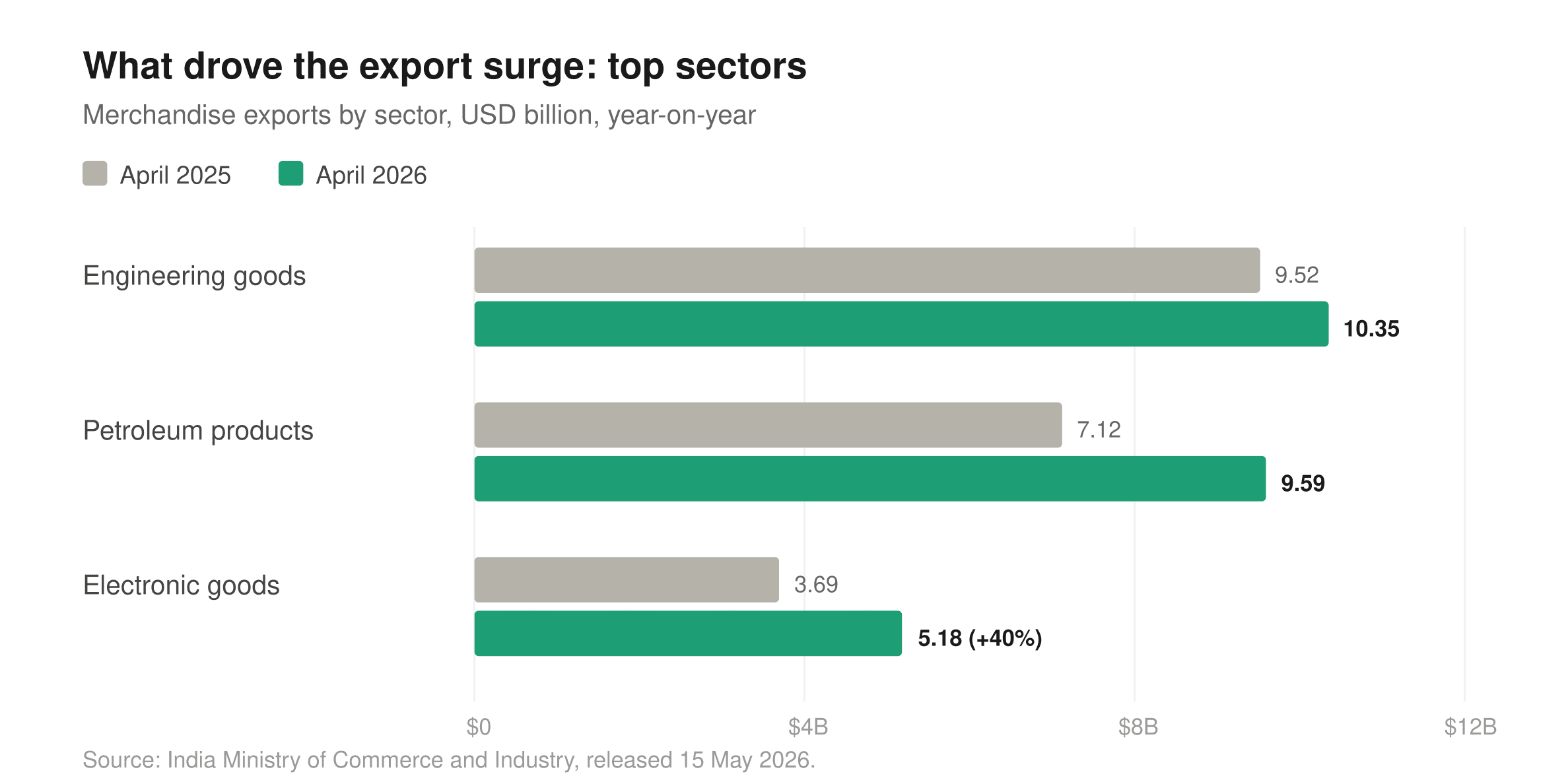
The growth was concentrated in exactly the high-value, manufactured categories that India's industrial policy has been targeting:
Strip out volatile petroleum, and the underlying signal is still healthy: non-petroleum merchandise exports registered a growth of 9.01 per cent in April 2026 compared to April 2025. This is the number that matters for assessing genuine competitiveness, because it removes the price-inflation distortion that affects both petroleum exports and imports.
The electronics surge is widely attributed to the cumulative effect of India's Production Linked Incentive (PLI) schemes, which have been pulling assembly and component manufacturing — particularly in electricals, electronics, and machinery — into the domestic base over several years.
One of the most underreported lines in the data is a dramatic shift in trade geography. Exports to Singapore jumped to USD 3.20 billion from USD 1.14 billion, while exports to the UAE declined to USD 2.19 billion from USD 3.43 billion.
That is a near-tripling of exports to Singapore alongside a sharp fall to the UAE — almost certainly a logistics-driven rerouting effect. With Gulf ports like Jebel Ali congested and Hormuz-dependent lanes disrupted, Singapore's role as a transshipment and re-export hub appears to be absorbing flows that would normally route through the Gulf. For supply-chain planners, this is a leading indicator: trade is physically rerouting around the chokepoint, and the country-level statistics are starting to show it.
The single most important contextual fact — and the one most often lost in deficit headlines — is the role of services. Despite the rise in imports, the country's overall trade deficit narrowed sharply to USD 7.81 billion in April 2026 from USD 11.16 billion a year ago, aided by strong growth in exports. Services exports of $37.24 billion against far smaller services imports produced a surplus large enough to absorb most of the bloated goods deficit.
This is the structural feature that distinguishes India from a typical commodity-importing economy under an oil shock: its IT, business, and professional services surplus acts as a built-in macro stabiliser. When you read "India's trade deficit widened," the accurate framing is: the goods deficit widened on an energy-price shock, but services cushioned the blow so effectively that the all-in external position improved year-on-year.
For the full year just ended, the resilience is visible at scale: India's total trade during FY 2025-26 reached a record USD 863.1 billion, compared to USD 825.3 billion in FY 2024-25, registering a growth of 4.6 per cent.
The April print is, paradoxically, an encouraging signal beneath an alarming headline. Demand for Indian electronics, engineering goods, and refined petroleum products is robust enough to hit multi-year records in the teeth of a shipping crisis and a tariff overhang. Exporters in these categories have pricing power and order momentum. The watch item is freight: with Cape-route diversions and elevated rates, margin compression on landed cost is the real near-term risk, not demand.
Anyone importing energy, electronics components, or Gulf-origin inputs should plan for sustained — not transient — disruption. Operational guidance circulating among trade advisors has shifted from treating the Hormuz situation as a short-term event to planning for alternative routing through the second half of 2026. Practical implications: longer transit times via the Cape route, elevated freight, congestion at alternative hubs like Jebel Ali and Singapore, and a higher probability of force-majeure clauses being triggered on Gulf-linked contracts.
The growth outlook now carries a visible energy-shock drag. Forecasters at BMI (part of Fitch) expect India's GDP growth to slow to 6.7% in FY2026/2027, down from 7.7% in FY2025/2026, attributing the deceleration largely to the oil price shock. The current account and fiscal accounts are under pressure from the energy bill even as the headline export number flatters the picture.
April 2026 is a case study in why a single India exports trade deficit number can mislead. India is simultaneously: (1) posting its strongest goods exports in over four years, (2) improving its all-in external balance year-on-year thanks to services, and (3) absorbing a serious, geopolitically driven energy-cost shock that has widened the goods gap to a three-month high. All three are true at once. The story is not "India's trade is deteriorating." The story is "India's export engine is proving resilient while its energy import bill is being held hostage by a chokepoint 3,000 kilometres away."
Q: What is driving the India exports trade deficit in April 2026? Strong exports were not the problem — imports were. Merchandise exports hit a four-year high, but a higher energy import bill, caused by the Strait of Hormuz blockade and the lapse of India's US waiver on Russian crude, pushed the goods deficit to a three-month high of $28.38 billion.
Q: Did India's exports actually grow in April 2026? Yes. Merchandise exports grew 13.78% year-on-year to $43.56 billion, the highest monthly figure in more than four years. The growth was real and broad-based across electronics, engineering goods, and petroleum products.
Q: If exports were strong, why did the trade deficit widen? Because imports grew faster in value terms — driven almost entirely by a higher energy bill. The Strait of Hormuz blockade and the lapse of India's US waiver on Russian crude forced India to buy costlier oil from alternative suppliers, inflating the import figure even where volumes fell.
Q: Did India's overall trade deficit widen or narrow? This is the key nuance. The goods deficit widened to $28.38 billion (a three-month high). But the overall deficit, which includes India's large services surplus, actually narrowed to $7.81 billion from $11.16 billion a year earlier.
Q: What is the Strait of Hormuz and why does it matter to India? It is a maritime chokepoint at the entrance to the Persian Gulf through which roughly 20–27% of the world's seaborne oil normally passes. It has been largely blocked since late February 2026 due to the Iran conflict. India, which imports over 85% of its crude, is among the most exposed economies because most Gulf oil bound for Asia transits this strait.
Q: Which export sectors performed best? Electronic goods (up roughly 40% to $5.18 billion), engineering goods (India's largest category, at $10.35 billion), and petroleum products ($9.59 billion). Non-petroleum exports grew a healthy 9.01%, indicating the strength is not purely a price effect and lead to India April exports trade deficit.
Q: Why did exports to Singapore nearly triple while UAE exports fell? This appears to be a logistics-driven rerouting effect. With Gulf ports congested and Hormuz-linked lanes disrupted, trade flows are physically rerouting through Singapore's transshipment hub, shifting where exports are recorded by destination and India April exports trade deficit.
Analysis based on data released by India's Ministry of Commerce and Industry on May 15, 2026, and contemporaneous reporting on the 2026 Strait of Hormuz crisis. Figures are official government data; interpretation and forward-looking analysis are the author's.
Enter your email to receive the latest trade insights, guides, and HS-code explainers from EximAgent Blog.