Skip to content

Technology

Why Ireland's Exports Fell 36.4% and What It Signals 2026

Ireland's exports crashed 36.4% in February 2026 as US pharma frontloading reverses. See what the tariff hangover means for global exporters in 2026.

April 28, 2026By Davos Pham5 min readView as Markdown
Share
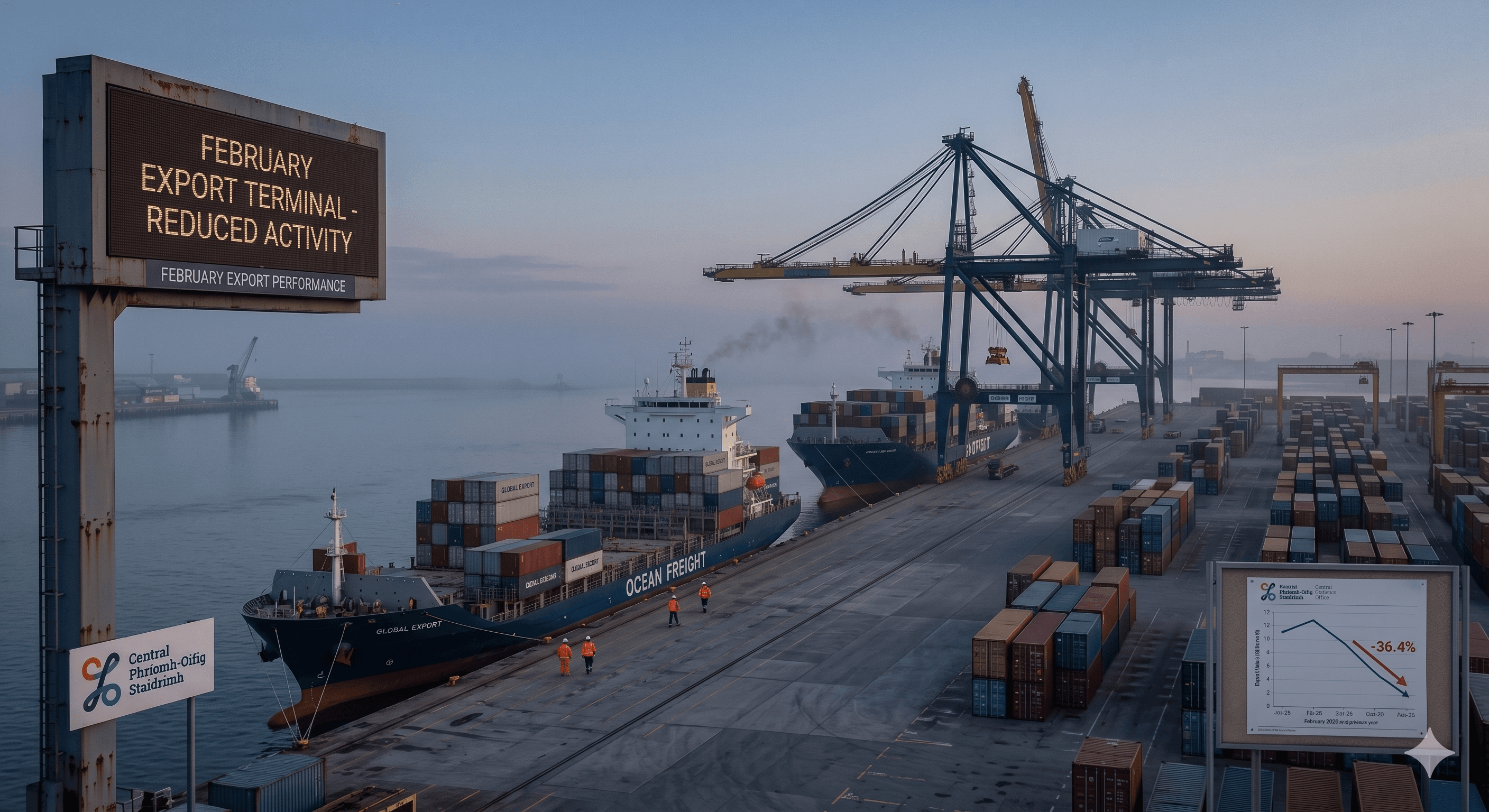
A wide-angle view of a quiet industrial shipping port during a foggy morning, illustrating a downturn in trade. A large cargo ship is docked at the pier with only a few containers on deck, while tall harbor cranes stand idle in the background. In the foreground, a digital signboard reads "FEBRUARY EXPORT TERMINAL - REDUCED ACTIVITY," and a smaller printed chart on a nearby post displays a sharp red arrow pointing downward next to the figure "-36.4%." The overall mood is somber and quiet, reflecting a significant decline in export volume.

Ireland's Exports Plunge 36.4%: The Tariff Frontloading Hangover Every Exporter Should Watch

Quick Answer

Exports sank by 36.4% to €15.9 billion in February after what the CSO said were 'exceptionally' high export volumes in 2025


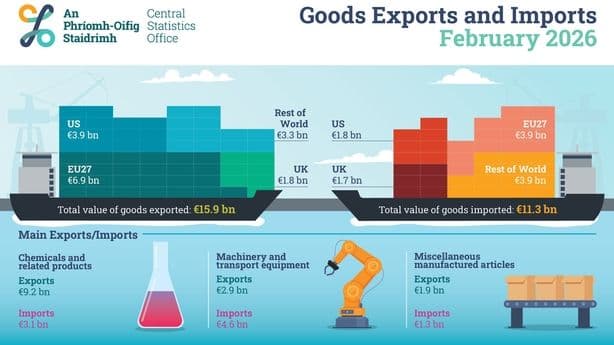
Ireland's goods exports collapsed 36.4% year-on-year to €15.9 billion in February 2026, with US-bound shipments crashing 69.7%. The drop is not a demand crisis — it's the unwinding of 2025's pharmaceutical frontloading rush ahead of US tariffs. Exporters globally should treat this as a leading indicator: tariff-driven distortions are now reversing across multiple trade corridors, and 2026 comparison baselines will remain skewed for months.

The Headline Numbers at a Glance

Metric

February 2026

YoY Change

Total exports

€15.9 billion

▼ 36.4%

Exports to US

€3.9 billion

▼ 69.7%

Total imports

€11.3 billion

▼ 6.1%

US share of exports

24.7%

Down from 51.8%

Chemicals & pharma exports

€9.2 billion

Still dominant

Top export partners (Feb 2026): United States (24.7%) → Netherlands (17.7%) → Great Britain (8.7%) Top import partners (Feb 2026): United States (16.1%) → Great Britain (11.7%) → China (8.5%)
Why This Matters for Importers and Exporters Worldwide

An infographic titled "Goods Exports and Imports February 2026" showing Ireland's trade balance. Two cargo ships are illustrated: the left ship represents total exports valued at €15.9 bn, with major destinations being the EU27 (€6.9 bn) and the US (€3.9 bn). The right ship represents total imports valued at €11.3 bn, with major sources being the EU27 (€3.9 bn) and the "Rest of World" (€3.9 bn). A bottom section highlights main commodity groups: Chemicals and related products lead exports at €9.2 bn, while Machinery and transport equipment lead imports at €4.6 bn.


1. The "Frontloading Hangover" Is a Global Pattern, Not an Irish Problem

In late 2024 and early 2025, exporters across Asia, Europe, and Latin America rushed shipments into the United States ahead of expected tariff hikes. Ireland's pharmaceutical sector was one of the most aggressive frontloaders — and now the reversal is visible in cold numbers.

If you ship to the US from Vietnam, India, Malaysia, or anywhere else, expect similar Y/Y distortions in your own data through Q2 and Q3 2026. Your sales team's "decline" may not be a real decline.

2. The Real Underlying Demand Is Flat, Not Falling

Both Ebury and Deloitte Ireland flagged the same point in the CSO release: compared to 2024 (a normal year), Ireland's exports are essentially stable. The 36.4% headline only exists because 2025 was abnormal.

Translation for exporters: Stop benchmarking 2026 against 2025. Use 2024 or a 24-month rolling average until tariff distortions clear.

3. Geopolitical Pressure Is Compounding the Reset

Cost pressures are stacking on top of the tariff unwind:

  • Iran conflict spillovers are pushing global energy and fuel costs higher
  • Shipping route volatility is raising freight and insurance premiums
  • ECB rate hike risk is back on the table, tightening working capital for exporters
  • Margin compression is hitting input-heavy manufacturers hardest

Expert Insight: How to Read This as an Export Operator

After working with hundreds of SME exporters across Vietnam, India, Malaysia, and the US through the EximAgent platform, here's what the Ireland data actually tells us:

✅ What experienced trade professionals should do now

  • Recalibrate your buyer pipeline assumptions. Buyers who frontloaded in 2025 are sitting on inventory. Their next purchase orders will be smaller and later than your CRM suggests.
  • Watch HS code-level data, not country totals. The €9.2B chemicals/pharma figure is masking very different stories in machinery, food, and consumer goods. Drilling into HS codes is the only way to see what's actually happening in your category.
  • Diversify away from single-market dependency. Ireland's US export share dropped from 51.8% to 24.7% in twelve months. That's how fast a "stable" trade corridor can shift. Netherlands and Great Britain absorbed part of the redirected flow — your secondary markets matter more than ever.
  • Stress-test FTA exposure. With tariff regimes shifting, your Free Trade Agreement coverage (or lack of it) is now a profit lever, not a paperwork detail.

⚠️ What to stop doing

  • Stop quoting YoY percentages in board reports without context
  • Stop assuming 2025 buyer behavior predicts 2026 buyer behavior
  • Stop tracking only "total exports" — track exports by HS code, by destination, by buyer concentration

What This Signals for the Rest of 2026

Deloitte's Louise Kelly captured the most important framing: "This is a reset after an exceptional year, with the real signal now emerging beneath the headline numbers."

For trade professionals, three things to monitor through Q2–Q3 2026:

  1. US tariff policy updates — any new tariff actions could trigger a second frontloading wave
  2. Shipping route disruptions in the Red Sea, Strait of Hormuz, and Panama Canal
  3. Comparable-period distortions in your own exports — the base effect from 2025 will keep skewing reports for at least 6 more months

Key Takeaways for Sales, Logistics, and Trade Teams

  • Ireland's 36.4% export drop is a base-effect story, not a demand collapse
  • Pharma frontloading to the US drove both the 2025 spike and the 2026 reversal
  • Real underlying export performance is flat vs. 2024 — not declining
  • Energy, freight, and financing costs are the next pressure points to watch
  • Country-level numbers hide the truth — HS code-level analysis is non-negotiable in 2026

How EximAgent Helps Exporters Navigate This Volatility

EximAgent and EximAgent are AI-powered trade intelligence tools built for exactly this kind of market — where headline numbers mislead and the real signal sits inside HS codes, buyer concentration, and FTA coverage.

  • 🔍 HS Code Intelligence — drill into your category at the tariff-line level, not the country level
  • 🎯 AI Lead Generation & Contact Hunter — find verified buyers in markets absorbing redirected trade flows (Netherlands, GB, GCC, ASEAN)
  • 📜 FTA Advisory — turn shifting tariff regimes into a margin advantage
  • 📊 Trade Data Analysis — see what your competitors are actually shipping, where, and to whom

The exporters who win in 2026 won't be the ones with the biggest 2025 numbers. They'll be the ones who saw the reset coming first.

Source: Ireland Central Statistics Office (CSO), April 2026. Commentary from Robert Purdue (Ebury Ireland) and Louise Kelly (Deloitte Ireland).

Share

Follow EximAgent for trade insights

Sign up for our newsletter

Enter your email to receive the latest trade insights, guides, and HS-code explainers from EximAgent Blog.