Technology
EximAgent vs Apollo vs TradeAtlas: Best for Exporters?
Jun 29, 2026
Technology
Trump's 2026 China trade policy pivots as tariffs stall. Explore critical compliance strategies for global supply chains.
May 18, 2026By Davos Pham10 min readView as Markdown
US China trade policy in 2026 has moved from aggressive tariff escalation toward a narrower “managed trade” approach. Trump’s tariffs reduced the bilateral goods deficit, but court rulings, China’s rare earth leverage, and contradictory decisions on chips and export controls have left importers facing high policy volatility rather than a clear decoupling strategy.
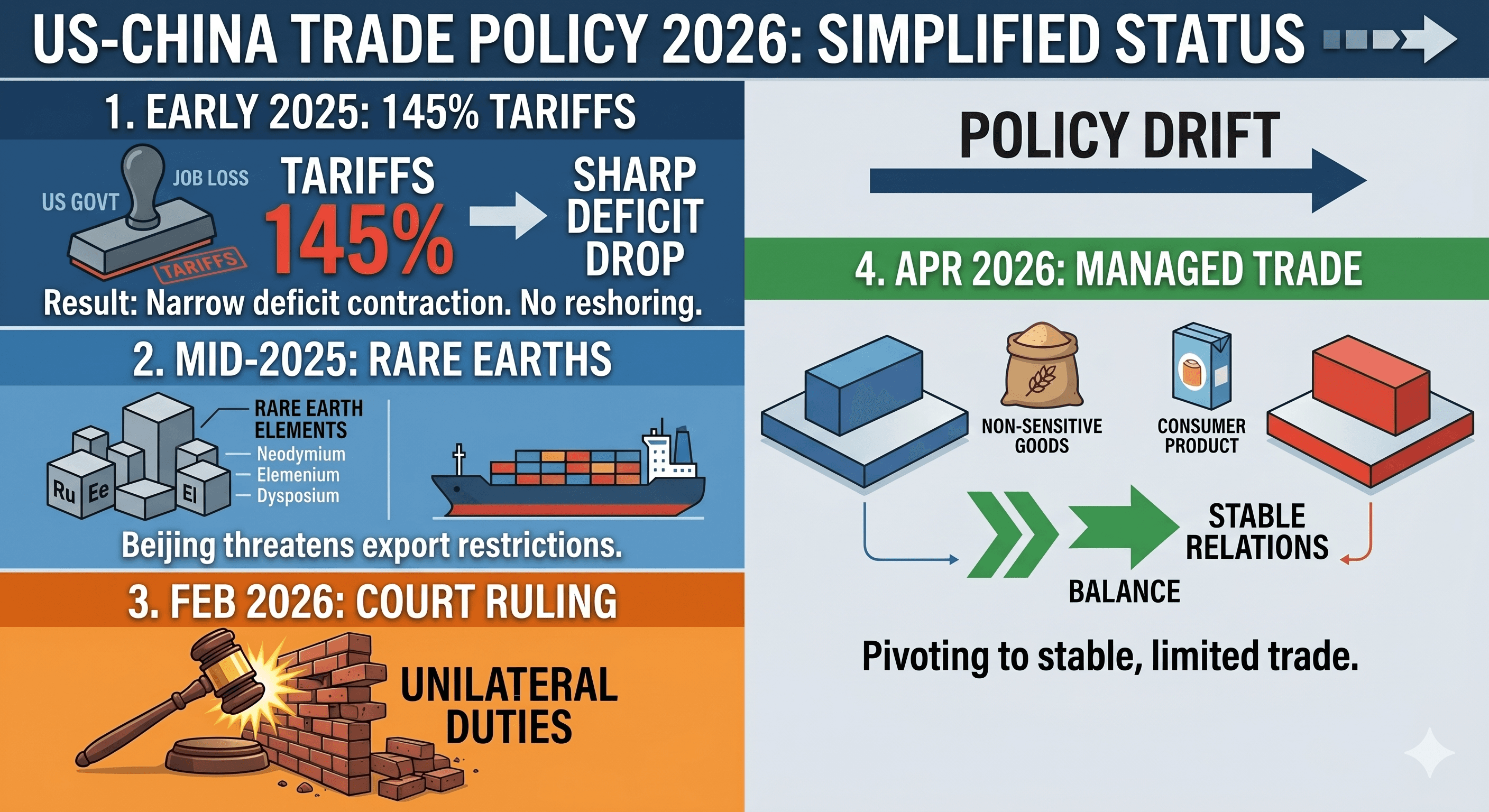
US China trade policy in 2026 is no longer defined only by tariffs. It is now a mix of partial tariff rollback, legal constraint, export-control uncertainty, rare earth pressure, and managed trade negotiations.
The original second-term Trump strategy began with a dramatic tariff broadside. Chinese goods faced rates that peaked near 145% in early 2025, according to reporting and legal summaries of the tariff program. The goal was to pressure Beijing on trade imbalances, industrial subsidies, intellectual property, and strategic competition.
By May 2026, that strategy had narrowed. The administration still uses tariffs, export controls, entity screening, and national-security reviews, but the central objective has shifted from broad economic decoupling to managed trade in non-sensitive goods.
For exporters and importers, the practical message is clear: do not plan around one headline tariff rate. Plan around HS-code-level volatility, transaction-time screening, and sudden policy reversals.
Visual placement: Chart 1
Timeline of US China trade policy from the 145% tariff peak in early 2025 to the May 14–15, 2026 Trump-Xi summit in Beijing.
Trump’s second-term China policy opened with tariffs reaching approximately 145% on many Chinese goods. The move was designed to force concessions from Beijing and redirect manufacturing back to the United States.
But the tariff strategy ran into three constraints:
The result was not a clean decoupling strategy. Instead, Washington moved toward selective relief, sector-by-sector controls, and negotiated carve-outs.
China’s most powerful response was not simply retaliatory tariffs. It was the threat to restrict exports of rare earth elements, which are critical to electric vehicles, wind turbines, semiconductors, defense systems, and advanced manufacturing.
Because China dominates rare earth refining and processing, the threat put pressure on US supply chains that tariffs alone could not resolve. For many importers, this is now the most important escalation indicator in US China trade policy 2026.
In February 2026, the US Supreme Court ruled that the International Emergency Economic Powers Act did not authorize the president to impose certain tariffs. Legal analysis from Faegre Drinker noted that the case involved tariff actions that had reached an effective rate of 145% on most Chinese goods.
That ruling did not end the trade war. But it weakened the administration’s ability to use emergency powers as the main legal foundation for broad tariffs.
The data shows a mixed outcome. Trump’s China tariffs appear to have reduced the bilateral deficit, but they did not produce the broader reshoring result promised by the administration.
Metric | Value | Period | Relevance |
|---|---|---|---|
Peak tariff rate on Chinese goods | ~145% | Early 2025 | Shows the scale of tariff escalation |
US goods trade deficit with China | $202 billion | 2025 | Deficit fell sharply from 2024 |
Change in US China goods deficit | -32% | 2024 to 2025 | Tariffs reduced bilateral trade imbalance |
US manufacturing jobs lost | 91,000 | Feb-Dec 2025 | Reshoring goal was not achieved |
Taiwan weapons sales approved | $11 billion | Dec 2025 | Shows security policy continued alongside trade talks |
Bottom line: The tariffs achieved the narrow goal of shrinking the US goods trade deficit with China, but they did not deliver a coherent China strategy, a manufacturing rebound, or a stable compliance environment.
Visual placement: Chart 2
Bar chart comparing the US goods trade deficit with China in 2024 versus 2025, highlighting the reported 32% decline.
One of the clearest examples was the December 2025 Nvidia H200 reversal. Trump approved sales of Nvidia H200 AI chips to China shortly after US officials had treated similar chips as national-security risks.
For trade compliance teams, the signal is uncomfortable: approval or restriction may depend on the transaction, timing, and political context, not only the product category.
In February 2026, the Pentagon reportedly published a blacklist of major Chinese technology companies accused of aiding the People’s Liberation Army, then withdrew it within roughly an hour.
That kind of reversal matters for exporters, banks, freight forwarders, and customs brokers. A buyer that appears clear in the morning may require re-screening before shipment, payment, or final documentation.
The administration also paused some export-control expansions and planned port fees on Chinese-built vessels after Beijing’s rare earth pressure. This reinforces a central lesson of US China trade policy 2026: policy volatility is structural, not temporary.
The US wants leverage. China has leverage. Businesses are stuck managing the gap between the two.
From EximAgent’s trade-intelligence perspective, the biggest operational risk in 2026 is not simply whether tariffs are “high” or “low.” The bigger risk is that tariff exposure can change quickly at the HS-code, origin, entity, or end-use level.
In past tariff cycles, many companies treated China risk as a country-level issue. That approach is now too blunt. Two products in the same HS-4 category can face different exposure depending on the 8- or 10-digit classification, component origin, end user, and whether the shipment touches a sensitive sector.
Need to check exposure by product?
Use the HS Code CLI to verify tariff exposure by product classification, or Try Trade Intelligence to monitor policy, supplier, and market signals across your trade workflow.
For importers, the practical discipline is:
In short: the compliance advantage now belongs to companies that treat tariff intelligence as a daily operating layer, not a quarterly legal memo.
Visual placement: Callout box
Importer checklist for China-origin goods: HS code verification, tariff scenario modeling, denied-party screening, rules-of-origin files, rare earth exposure review.
Turn policy analysis into action:
Try Trade Intelligence for live trade monitoring, or use the HS Code CLI for product-level tariff checks.
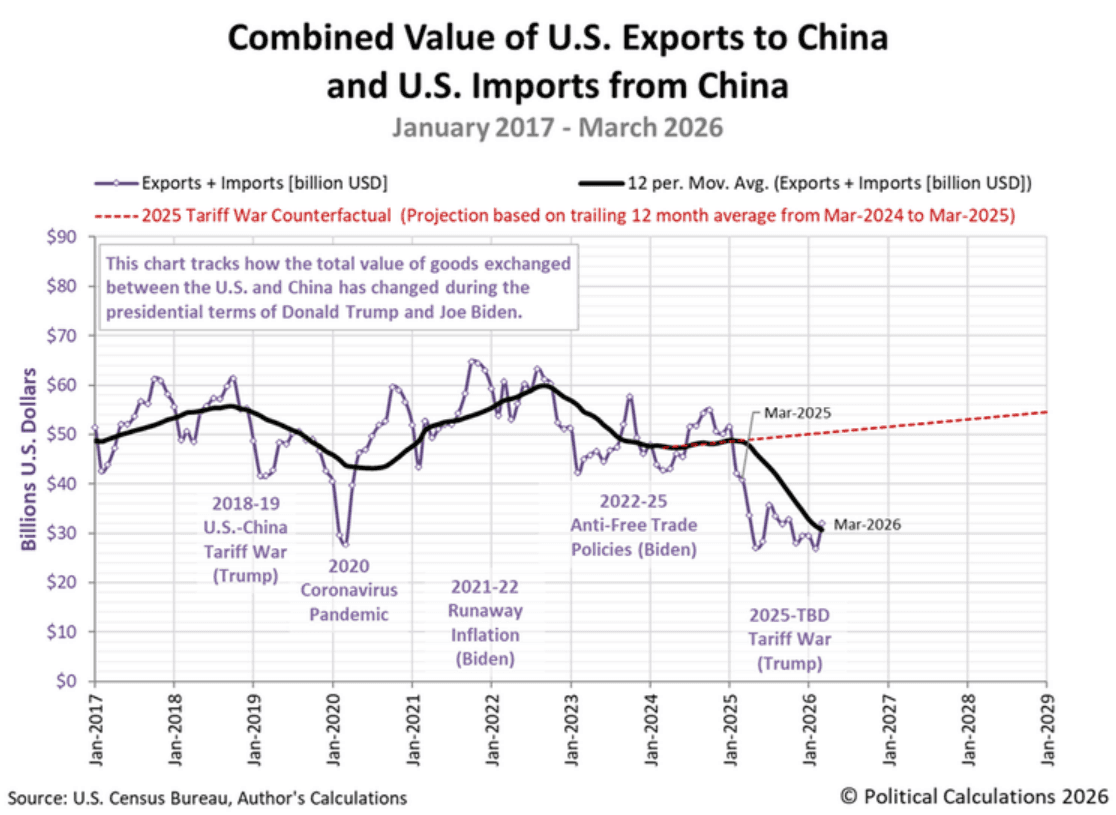
Source: https://seekingalpha.com/article/4900158-fall-direct-us-china-trade-showing-signs-bottoming
Importers should assume that US China tariffs in 2026 can change by product, sector, and negotiation cycle.
Recommended actions:
Exporters should focus on whether their product falls inside or outside sensitive categories.
Lower-risk categories may include:
Higher-risk categories include:
The administration’s “managed trade” framing suggests that non-sensitive commerce may remain open, while strategic sectors face tighter review.
Vietnam, Malaysia, Mexico, and other rerouting hubs remain under transshipment scrutiny. Companies should not assume that moving production or final assembly outside China automatically removes tariff exposure.
Customs teams should document:
Rules of origin are now a direct tariff-risk control.
The Trump-Xi summit took place May 14–15, 2026, in Beijing. Official White House materials show Trump and Xi meeting at the Great Hall of the People on May 14, 2026.
The summit matters because it confirms that US China trade policy has moved into a negotiation-heavy phase. The administration is still confrontational, but it is no longer relying only on tariff shock.
Three outcomes now matter for trade professionals:
The summit does not remove uncertainty. It organizes it. Importers should treat the post-summit period as a watch window for tariff notices, export-control updates, and entity-list changes.
Visual placement: Image
Trump-Xi meeting in Beijing, May 2026. Suggested caption: “President Donald Trump and President Xi Jinping meet at the Great Hall of the People in Beijing on May 14, 2026. Source: White House, if licensed for use.”
US China trade policy in 2026 is a hybrid of tariffs, export controls, rare earth negotiations, entity screening, and managed trade. The policy has shifted away from broad decoupling toward selective trade stability in non-sensitive goods.
Partly. The tariffs helped reduce the US goods trade deficit with China by about 32% to $202 billion in 2025, but they did not produce a manufacturing rebound. The US lost 91,000 manufacturing jobs between February and December 2025.
Managed trade means the US and China negotiate trade flows, tariff relief, purchase commitments, and sectoral carve-outs directly. In 2026, it refers to a narrower strategy focused on stable commerce in non-sensitive goods rather than full economic decoupling.
Importers should verify HS codes, model multiple duty scenarios, screen counterparties at transaction time, document rules of origin, and monitor rare earth export controls. The biggest risk is not just tariff level; it is sudden tariff and compliance volatility.
Managed trade is a system where governments negotiate trade levels, tariff treatment, quotas, or sector carve-outs bilaterally instead of relying only on broad free-trade rules. In the 2026 US China context, it means stable trade in non-sensitive goods while strategic sectors remain restricted.
Rare earth elements are 17 metallic elements used in magnets, EV motors, wind turbines, semiconductors, and defense systems. China dominates global refining and processing capacity, giving Beijing significant leverage.
Rules of origin determine the national source of a product for tariff and trade-agreement purposes. They are especially important when goods move through countries such as Vietnam, Malaysia, or Mexico before entering the United States.
Editorial note: This article is trade-policy analysis for export-import professionals. It is not legal, tax, or customs advice. Consult a licensed customs broker or trade attorney for transaction-specific guidance.
Enter your email to receive the latest trade insights, guides, and HS-code explainers from EximAgent Blog.