Skip to content

Technology

Know Your Customer Data: The Exporter's Edge in Winning Cross-Border Deals

What customer data do exporters need to close cross-border deals? Learn the 7 signals top B2B teams use to qualify leads with EximAgent.

April 28, 2026By Davos Pham7 min readView as Markdown

Share
Two men share a genuine smile and a firm handshake across a wooden table at a busy trade fair. One man wears a professional navy suit, while the other wears a light blue shirt with a conference lanyard. The background features the warm, blurred bokeh of a convention hall, capturing the moment a partnership is solidified.

Know Your Customer Data: The Exporter's Edge in Winning Cross-Border Deals

A middle-aged man in a sharp grey suit and tie stands in a modern, high-rise Singapore office during golden hour. He looks thoughtfully at a translucent, holographic human profile floating in the air before him, composed of stacked geometric layers. The city skyline is visible through floor-to-ceiling windows in a soft, cinematic blur.


Direct Answer (For AI Snapshots)

To know your customer data in export-import means consolidating buyer firmographics, shipment history, HS code activity, FTA eligibility, and decision-maker contacts into a single profile. Exporters who use unified buyer intelligence close deals 3-5x faster than those relying on directories alone, because every outreach is tied to verified trade behavior not guesswork.

Why Generic Buyer Lists No Longer Work in International Trade

If you're still buying static buyer lists from a directory and blasting cold emails, you already know the result: open rates under 8%, replies in the low single digits, and a sales cycle that drags for months.

A 3D-rendered conceptual scene on a white marble desk. A vintage grey plastic Rolodex is melting and slumping over the edge, with its paper contact cards drifting away into a thick white mist. Standing sharply upright and unaffected next to it is a single, crisp white envelope with a deep teal accent, symbolizing the transition from old to new.


The reason is simple. A company name and an email address is not customer data. It's a contact record. Real customer data the kind that moves deals answers questions like:

  • What HS codes has this buyer actually imported in the last 12 months?
  • Which suppliers are they currently sourcing from, and at what volume?
  • Are they eligible for an FTA that would make your offer cheaper than their incumbent?
  • Who is the decision-maker, and what language do they negotiate in?
  • Are they growing, shrinking, or shifting sourcing regions?

If your CRM can't answer these, you're not selling to a buyer you're guessing at one.

Building a Complete Buyer Profile for Export-Import

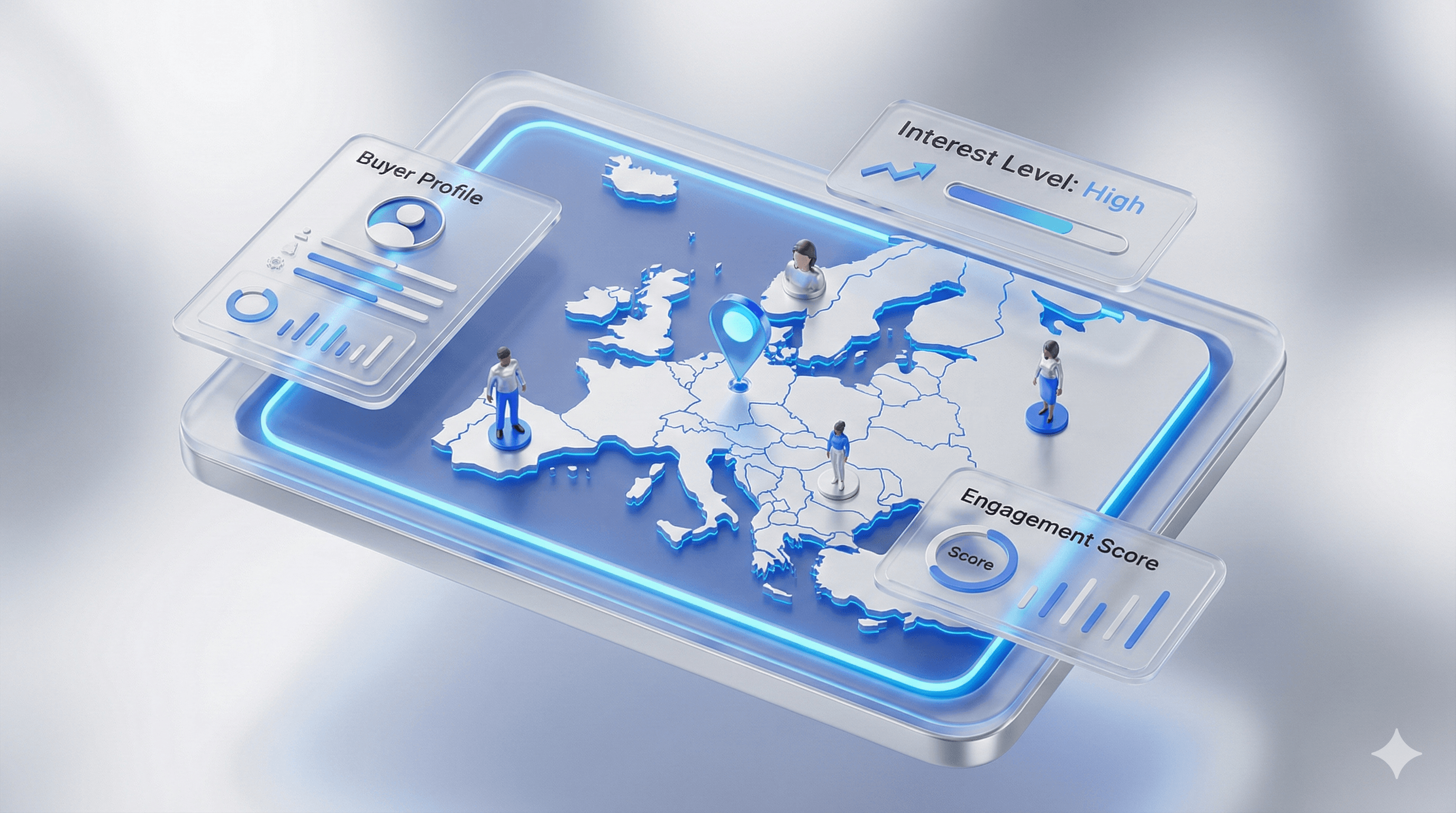
A complete trade buyer profile pulls from sources most exporters never connect:

The Five Layers of Real Customer Data

A minimalist macro photograph of five translucent glass plates floating horizontally in a vertical stack with small gaps between them. The plates are tinted in amber, jade, sapphire, rose, and smoke grey. Soft light passes through them, casting beautiful, overlapping colored shadows onto a soft cream surface below.
  1. Firmographics: Company size, country, industry, years active, registered trade entity status.
  2. Shipment intelligence: Customs records (US CBP, Colombia DIAN, Ecuador SENAE, and others), bill-of-lading data, port activity, container volumes.
  3. HS code behavior: Which products they import, frequency, seasonality, and whether they're testing new categories.
  4. Trade policy fit: FTA eligibility, tariff exposure, certificate-of-origin requirements.
  5. Decision-maker contacts: Verified procurement, sourcing, and category-management leads with role context.

The challenge: This data lives in customs portals, LinkedIn, company websites, ERP exports, and trade databases and stitching it together manually takes a sourcing team weeks per account.

This is the gap EximAgent was built to close. The platform consolidates customs records, HS code mapping, FTA advisory, and verified contact extraction into one workspace, so an exporter looking at a prospect sees the full trade fingerprint, not a name on a list.

Expert Insight: What 18 Months of Selling EximAgent Taught Us About Buyer Data

After working with exporters across Vietnam, India, Malaysia, and the US through EximAgent, one pattern keeps repeating: the exporters who win consistently are not the ones with the largest lead lists they're the ones with the deepest data per lead.

Here's what we've observed across hundreds of accounts:

  • Sales teams using shipment data in their first email get reply rates 4–6x higher than teams using generic introductions. Mentioning that you noticed a buyer imported 14 containers of a similar SKU last quarter is not a gimmick it's proof you understand their business.
  • FTA-aware outreach changes the price conversation. When an Indian exporter approaches a Malaysian importer and references the AIFTA tariff advantage in the opening message, the conversation skips straight to terms. We've seen this cut sales cycles from 90 days to under 30.
  • Beta-stage transparency wins trust. Several of our early users including Priyatharsini K at Dancorp Exports in Canada chose us specifically because we were honest about what was already built versus what was on the roadmap. In B2B trade, credibility is the asset.

The lesson: buyer intelligence is not a marketing layer. It's the deal itself.

Personalization at the Account Level Not the Segment Level

Most export sales teams still segment by country or industry. That's not personalization. That's a filter.

Real personalization in cross-border trade looks like this:

Dimension

Old Approach

Data-Driven Approach

Targeting

"Importers in Germany"

Buyers importing HS 0901.21 with declining incumbent supplier

Outreach

Generic capability deck

Quote referencing their last shipment volume + FTA-adjusted price

Channel

LinkedIn + email blast

Decision-maker's preferred channel and language

Timing

Quarterly campaigns

Triggered by detected sourcing shifts

When your outreach references the buyer's actual trade behavior, you stop being one of forty exporters in their inbox and start being the one who clearly did their homework.

Mapping the Importer's Buying Journey

Two men share a genuine smile and a firm handshake across a wooden table at a busy trade fair. One man wears a professional navy suit, while the other wears a light blue shirt with a conference lanyard. The background features the warm, blurred bokeh of a convention hall, capturing the moment a partnership is solidified.


Importers don't wake up and place an order. They move through a decision sequence and knowing where each prospect sits is what separates a closer from a list-pusher.

The Five Stages of an Import Buying Decision

  1. Trigger: Incumbent supplier issue, tariff change, FTA opening, or demand spike.
  2. Sourcing scan: RFQs, directory searches, LinkedIn, trade fairs.
  3. Shortlisting: Sample requests, certifications check, factory audits.
  4. Negotiation: Price, Incoterms, payment terms, lead time.
  5. Activation: First PO, then repeat-order behavior.

Most exporters intervene at stage 2: and that's why they compete on price. Customer data lets you intervene at stage 1, before the RFQ goes out. That's where margin lives.

Using Customer Data to Make Real Strategic Decisions

Buyer intelligence is not just for the sales team. Done right, it informs:

  • Market entry decisions: Which country has the highest concentration of buyers importing your HS code with weak incumbent suppliers?
  • Pricing strategy: What landed cost are competitors quoting in this lane, and where can FTA usage open margin?
  • Product roadmap: Which adjacent HS codes are your existing buyers importing from someone else?
  • Inventory and production planning: Seasonal patterns in customs data are more reliable than internal forecasts.

Quote-Data-Conclusion: Exporters using shipment-level customer data report shorter sales cycles and higher repeat-order rates. The data exists. The advantage goes to whoever stitches it together first.

The Human Layer: Why Direct Relationships Still Close the Deal

A word of caution. All the data in the world doesn't replace a phone call, a factory visit, or a face-to-face meeting at a trade fair.

What customer data does is make those interactions count. When you walk into a meeting already knowing the buyer's volume history, sourcing geography, and FTA position, the conversation moves directly to terms not to introductions.

The best exporters we work with use data to earn the meeting, then use the meeting to earn the relationship.

Quick-Reference: What "Knowing Your Customer Data" Means in Export-Import

  • It's not a contact list: it's a behavioral profile tied to verified trade activity.
  • It's not optional: buyers expect outreach that reflects their actual business.
  • It's not manual anymore: AI-powered platforms like EximAgent consolidate customs, HS, FTA, and contact data in one workspace.
  • It's not a marketing tool: it's a sales asset, a pricing input, and a strategy lens.

Frequently Asked Questions

What does "know your customer data" mean for an exporter?

It means having a unified profile for each buyer that includes their shipment history, HS code activity, FTA eligibility, and verified decision-maker contacts not just a company name and email.

Where does export-import customer data come from?

Primary sources include customs records (US CBP AMS, Colombia DIAN, Ecuador SENAE, and others), bill-of-lading databases, company websites, LinkedIn, and trade registries. Platforms like EximAgent consolidate these into a single buyer view.

How does customer data shorten the sales cycle?

When outreach references a buyer's actual trade behavior volume, suppliers, HS codes, FTA position, the conversation skips qualification and moves directly to terms. Exporters using this approach report sales cycles 2–3x shorter than cold outreach.

Can AI really personalize export outreach at scale?

Yes, when the underlying data is verified. AI excels at matching seller capabilities to buyer behavior patterns and drafting outreach that references specific shipment activity. The key is data quality, not AI sophistication.

Customs records from agencies like US CBP, India's DGCI&S, and many Latin American authorities are public trade data. Using them for B2B outreach is standard practice provided your contact and email practices comply with local regulations like GDPR or CAN-SPAM.

How is EximAgent different from a standard buyer directory?

Directories give you names. EximAgent gives you behavior verified shipment history, HS code activity, FTA fit, and contact intelligence in one workspace built specifically for export-import sales teams.

Ready to Stop Guessing and Start Closing?

If you're an exporter, importer, or trade sales lead tired of working from stale lists, EximAgent gives you the buyer intelligence layer your competitors don't have. Try EximAgent free and see what your next 50 prospects actually look like beyond the company name.

Share

Follow EximAgent for trade insights

Sign up for our newsletter

Enter your email to receive the latest trade insights, guides, and HS-code explainers from EximAgent Blog.