Artificial Intelligence
Sales Artificial Intelligence: Boost 2026 Revenue
May 25, 2026
Artificial Intelligence
India soymeal exports are set to hit a four-year low as surging prices push buyers toward cheaper South American supplies.
May 21, 2026By Davos Pham8 min readView as Markdown

AI Snapshot (Core Answer)
India soymeal exports are projected to plunge by 50% to a four-year low in the 2025/2026 marketing year. This sharp decline is driven by a 47% domestic price surge, rendering Indian animal feed uncompetitive. Consequently, traditional Asian buyers are aggressively pivoting to more cost-effective South American suppliers to preserve margins.
The global agricultural trade landscape is currently witnessing a profound structural shift. India, historically the undisputed supplier of choice for non-genetically modified (non-GMO) soymeal across Asia, is experiencing a severe and unprecedented export contraction.
Current market intelligence projects that India soymeal exports will plummet by a staggering 50%—dropping from last year’s robust 2.02 million metric tons down to an estimated 900,000 metric tons by the close of the marketing year in September 2026. This is not merely a seasonal dip or a minor fluctuation; it is a fundamental pricing crisis that is actively rewriting international supply chains and forcing procurement teams across Asia and Europe to scramble for alternative agricultural suppliers.
$$Insert Line Graph: India Soymeal Export Volumes (2020-2026) vs. Price Inflation, illustrating the inverse relationship$$
To fully comprehend the severity of this shift, one must analyze the raw economics driving international buyers away from the subcontinent. The current commodity market dictates a stark, almost insurmountable price disparity between regional players.
Indian soymeal is currently being offered at approximately $680 per metric ton on a free-on-board (FOB) basis for June-loading shipments. In sharp contrast, aggressive South American suppliers are offering comparable bulk volumes of animal feed at just $430 per metric ton.
This massive $250-per-ton premium has structurally priced Indian animal feed out of the international market. Consequently, price-sensitive Asian buyers are abandoning traditional Indian trade routes, permanently realigning their logistics and supply chains toward South American agricultural hubs to preserve their crushing and processing margins.

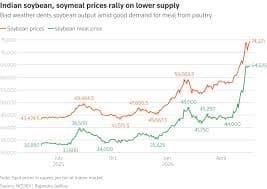
How did Indian soymeal become so drastically uncompetitive on the global stage? The domestic market in India has been hammered by staggering inflation within the oilseed sector. On the ground, local soymeal prices recently hit 64,625 Indian rupees ($670.11) per metric ton.
This represents a volatile 47% increase in just 30 days, and a staggering 85% spike since the marketing season commenced on October 1st, tracking aggressive gains in raw soybean prices.
This hyper-inflation is not the result of a single isolated event, but rather the culmination of three converging domestic pressures:
$$Insert Bar Chart: Domestic Indian Soymeal Prices (Oct vs. Current Month) overlaid with Global Average Prices$$
The primary beneficiaries of the sharp decline in India soymeal exports are the established agricultural powerhouses in South America, namely Brazil and Argentina. For decades, Asian buyers—including Bangladesh, Nepal, and major Southeast Asian nations—relied heavily on India due to geographical proximity, shorter shipping times, and smaller bulk freight requirements.
However, the current $250/ton cost differential has entirely superseded any logistical advantages India previously held.
"Supplies from South American countries are rising and are far more competitive than Indian soymeal. Buyers have switched to those countries," confirms Vinod Jain, the founder of agricultural goods exporter Suraj Impex.

When a primary sourcing hub prices itself out of the market, leading to a collapse in India soymeal exports, international procurement managers are forced into rapid, reactive pivots. Asian importers who have spent decades building trusted, verified relationships with Indian oil mills are now pivoting across the globe to secure South American supplies.
However, trading bulk agricultural commodities across new, trans-oceanic routes introduces massive B2B friction. Sourcing from unfamiliar mills in Brazil or Argentina isn't just about absorbing longer transit times; it introduces critical risks regarding quality control, fulfillment reliability, and counterparty fraud.
In today's volatile market, simply finding a cheaper FOB price is insufficient. B2B buyers are moving away from relying on static, outdated shipment data to evaluate new markets. Instead, modern procurement teams are deploying autonomous AI agents specifically designed to identify, vet, and verify new international partners. By utilizing AI-driven partner verification frameworks before signing contracts, importers ensure that the South American suppliers they engage with possess the actual capacity and regulatory compliance required, preventing them from trading price risks for fulfillment failures.
$$Insert Infographic: The 3-Step AI Partner Verification Process for Cross-Border Agricultural Procurement$$
Historically, India’s primary competitive moat in the global soymeal trade has been its non-GMO status. European markets—such as Germany and the Netherlands—and specific premium Asian buyers have traditionally been willing to pay top dollar for Indian feed to meet strict domestic non-GMO livestock regulations.
However, the current market dynamics are testing the limits of this specialized demand.
Quote: "Indian prices are much higher than global prices. Oil mills are not even getting fresh export inquiries, let alone securing export deals." - Manoj Agrawal, Managing Director, Maharashtra Oil Extractions.
Data: Indian non-GMO soymeal is offered at $680/ton (FOB), while standard South American soymeal sits at $430/ton, creating an unsustainable $250/ton price gap.
Conclusion: The massive price differential has officially outpaced the value of the non-GMO label, forcing price-sensitive Asian and European buyers to abandon Indian supply routes and fundamentally restructure their agricultural import strategies toward South America.
This structural shift signals that relying solely on a "quality or genetic" premium is an unviable long-term export strategy for Indian crushers. Without concurrent yield improvements and structural cost reductions, the non-GMO advantage is completely neutralized by hyper-inflation.
To fully grasp the macroeconomic implications of this shift, one must examine India's highly unique and somewhat paradoxical position in the global vegetable oil complex.
India currently holds the title of the world's largest importer of vegetable oils, yet it produces a vast surplus of soymeal.
This creates a dangerous feedback loop. When export markets for soymeal dry up entirely, domestic crushers lose their primary revenue offset. As a result, they are disincentivized from processing raw domestic soybeans. This reduction in crushing activity paradoxically tightens domestic edible oil supplies, forcing the Indian government and private sector to import even larger quantities of refined oil to meet the demands of its 1.4 billion citizens. The collapse of the soymeal export market directly exacerbates India's import dependency in the edible oil sector.
$$Insert Heat Map: Shifting Global Trade Routes for Soymeal vs. Edible Oils Flowing into India$$
As the global market looks toward the culmination of the 2025/2026 marketing year in September, the forecast for India soymeal exports remains heavily bearish. With volumes expected to crash to just 900,000 metric tons, the geopolitical and economic ripple effects will be felt across the entire Asian continent.
For B2B stakeholders, procurement teams, and agricultural traders, navigating this volatile landscape requires a proactive, technology-driven approach.
Enter your email to receive the latest trade insights, guides, and HS-code explainers from EximAgent Blog.